Journal
Shorter, in-the-moment notes. This is where I post:
Individuals - ideas from shapers and thinkers as public blueprints.
Weekly Connections – a summary of what I learnt each week.
Conference Notes – takeaways from events in space, finance, and technology

Weekly Connections #1
Plato, Alphabets, Logic & Space Risk
Each week I’m asking myself a simple question:
What new connection did I make across disciplines that could one day create value for others?
This week’s connection: ancient philosophy + alphabets + Euclid + AI-driven space-risk systems.
The connection
I finished my first blog post on Plato’s Republic, kept going with Aristotle’s Nicomachean Ethics, completed Lesson 1 of mathematics (Aristotle’s logic + Euclid’s Book I), pushed further into Arabic writing, and read a stack of pieces on modern space politics and AI, including:
US–Middle East space partnerships
Arguments for a Yuma spaceport and a southern launch corridor
The “fallacy of being first” in Moon/Mars exploration
AI for environmental change detection and military C2
Non-Earth imaging and space-to-space surveillance
On paper these look unrelated.
But they’re all training the same muscle: the ability to live and think inside a structure.
Plato and Aristotle → how to order a life and a city.
Euclid → how to order arguments and proofs.
Arabic → how to order sounds and meaning on the page.
Space policy & AI articles → how nations and companies try to order power, risk, and infrastructure in orbit.
Those are exactly the questions I’m trying to solve with AION:
how to design systems for space insurance where logic, incentives, data, and behaviour stay in harmony instead of colliding.
Plato’s tripartite psychology (reason, spirit, appetite) is slowly turning into a design lens for AION architecture.
Euclid is teaching me the logic of structure.
Arabic is teaching me the discipline of symbols.
Space politics is teaching me how those inner structures meet real-world power.
Together, they’re forming an inner blueprint for how to build outer systems.
What I studied
Plato & Ethics
Finished Republic and published my first long-form reflection.
Read Books 7–9 of Aristotle’s Nicomachean Ethics (pleasure, friendship, character).
Mathematics – Lesson 1 (Ancient Method)
Studied Aristotle’s logical structure: terms, propositions, syllogisms.
Copied Euclid’s Definitions, Postulates, and Common Notions by hand – the old Newton/Franklin method.
Wrote my own small “First Principles” page: personal definitions, axioms, and a syllogism.
Completed a first mini-proof (“the whole is greater than the part”) and did basic logic + geometric reasoning exercises.
Arabic (Lessons 2–4)
Now comfortable writing and joining all 28 letters.
Starting to recognise word patterns and write with more flow.
Historical & Intellectual Research
Watched deep dives on Jefferson, Franklin, Washington and added notes into my School of Thought database.
What I researched (space, AI & policy)
AI infra & orchestration maps
Frameworks for how LLMs, agents, retrieval and tools fit together.
Confirmed that AION sits in the workflow/orchestration and risk infra layers, not as “just another app”.
Reinforced the decision to build a Context + Memory Engine and AI Council instead of scattering RAG scripts everywhere.
Agentic systems & token efficiency
Threads on using fewer tokens, more tool calls, and lightweight local models.
Fed directly into the idea of the AI Council as a cost-aware “Code Mode” layer, not a giant prompt that does everything.
Founder/operator reality checks
Lists of what solo builders actually end up doing: product, sales, decks, infra, support.
Helpful as a sanity check: AION can start as a solo “Jarvis-for-space” lab, but real traction will probably need partners and a focused wedge.
20s philosophy & “rock bottom on purpose”
Advice threads about upskilling, embracing discomfort, and rejecting the default 9–5 → 40–year ladder.
Lined up almost eerily with what I’m doing: deliberate reset at 27, rebuilding identity around systems thinking and the space economy.
“Don’t build from scratch” & YC-style takes
Opinions that in the current AI era, pure from-scratch full-stack coding is a bad use of time for non-engineers.
Validated my own stance: lean heavily on AI tools + existing infra, focus my energy on architecture, risk logic, and product design.
Personal Jarvis & local GPU dreams
Threads about running your own local stack and having a home “AI rig”.
This clicked as a long-term aspiration: an at-home GPU + AION stack acting as my private space-risk lab, not just cloud prompts.
What I built
AION Module 1 — Phase 4
Tested the latest UI sprint for the AION Space Risk Engine.
Continued shaping the risk simulator around a mission-phase timeline instead of generic “cards”.
Started treating Perplexity as a real research assistant, not just a flashy Google.
Research Database v1
Created a new structure for tracking ideas across space, AI, engineering, history, risk, and philosophy.
It feels like moving from “collecting links” to building a long-term mental operating system.
Brand foundations
Cleaned and relaunched my X account for public experiments.
Redesigned my Squarespace site to feel more cohesive.
Published my Plato’s Republic reflection.
Workspace upgrade
New chair, new bookshelf – Monk Mode shouldn’t happen on a collapsing chair and a pile of boxes.
Small takeaways
Systems borrowed from philosophy (Plato / Aristotle) are surprisingly powerful blueprints for software architecture and risk governance.
Alphabets and axioms look simple, but they’re really interfaces into much larger systems – get them right early.
Writing Euclid by hand did more for my clarity than any modern tutorial.
Ancient philosophers argued about how to order a city; modern builders argue about how to order AI systems and careers. The underlying problem is the same: how to live and build inside a structure that doesn’t waste your one life.
A research database plus good tools (like Perplexity) is a quiet unlock: less hunting, more thinking.
Slow, foundational learning compounds – especially in mathematics, languages, and systems design.

Finovate Europe 2025: Conference Review
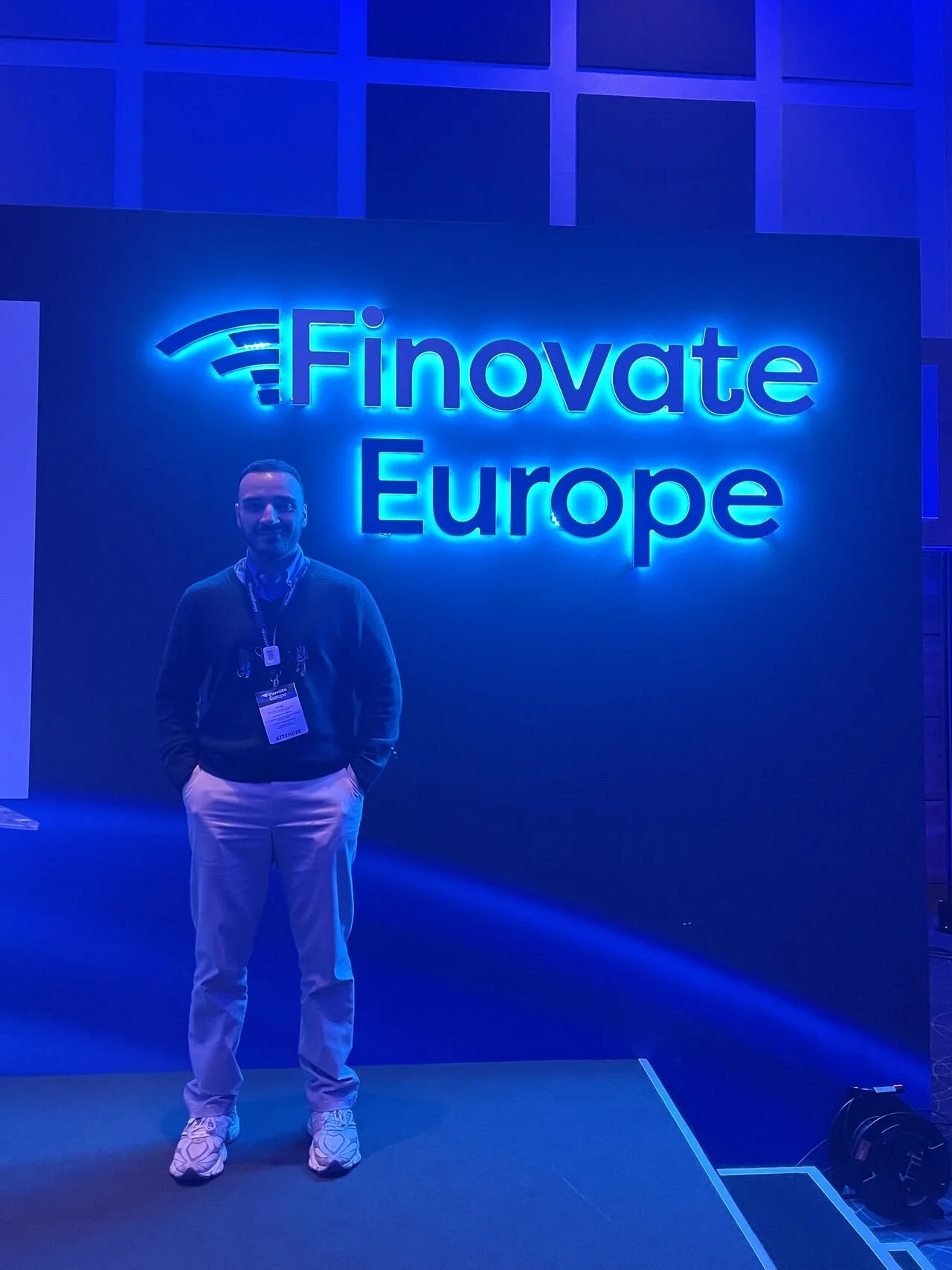
I attended Finovate Europe 2025, a major fintech conference in London that brings together banks, startups, and investors to showcase what’s next in finance. It’s fast-paced — product demos, keynotes, and discussions on everything from AI to digital payments — all packed into two days.
It was my first professional conference in London, and I honestly had fun. It felt like walking into the centre of financial innovation — a mix of sharp suits, startup energy, and endless conversations about what’s changing next.
Why I Went
The two-day delegate pass cost around £1,100, which included breakfast, lunch, evening drinks, and full access to every attendee’s contact details through the event app.
That’s the standard rate, but there were discounts available for students, press, startups, and small businesses, which makes it a bit more accessible depending on your category.
For founders, product teams, or anyone selling something, that level of access is gold. For someone like me — still researching, learning, and exploring the landscape — it was more mixed value. I didn’t go to pitch anything; I went to see where the industry is heading, talk to builders, and understand how data, AI, and regulation are reshaping finance.
There were also book signings, plenty of freebies from companies, and demo sessions that made the event surprisingly engaging. Watching startups pitch live and seeing real products on stage made it feel less theoretical and more tangible. The tech demos were genuinely fun to watch — fast, competitive, and inspiring.
What I Learned
1. Banks Are Turning Data Into Infrastructure
From the Analyst All-Stars Panel, the message was clear:
European banks see compliance as the foundation of their digital strategy.
Asia’s fintech adoption continues to lead globally.
Real-time payments are now an expectation, not a feature.
Regulation is a catalyst — the smartest firms treat it as a strategic advantage.
Banks are quietly reorganising around data as infrastructure — not just as an output. That shift is changing everything from risk management to customer experience.
2. Agentic AI Is the Next Phase
AI came up in nearly every talk. What stood out wasn’t hype, but a practical playbook for adoption:
Start with low-risk, internal use cases.
Use proven models (OpenAI, Claude) before custom builds.
Make AI everyday-use, not an IT project.
Always go through compliance, never around it.
One session highlighted the #1 impactful use case across the industry:
Strategic foresight — co-piloting decisions with AI.
It’s a shift from analytics to autonomy — systems that think, assist, and learn. That idea stuck with me because it connects directly to what I’m trying to understand: intelligent risk models that feel more like assistants than dashboards.
3. Pure AI-Native Models Are Coming
The most interesting line I heard:
“What are the models we can’t imagine yet?”
Right now, most fintech startups are just adding AI on top of old processes. But the next generation will be AI-native — companies built entirely around autonomy, data, and real-time decision-making.
Just as Facebook wasn’t a better MySpace, it was a new category — the same will be true for fintech. The winners won’t just digitise banking; they’ll redefine it.
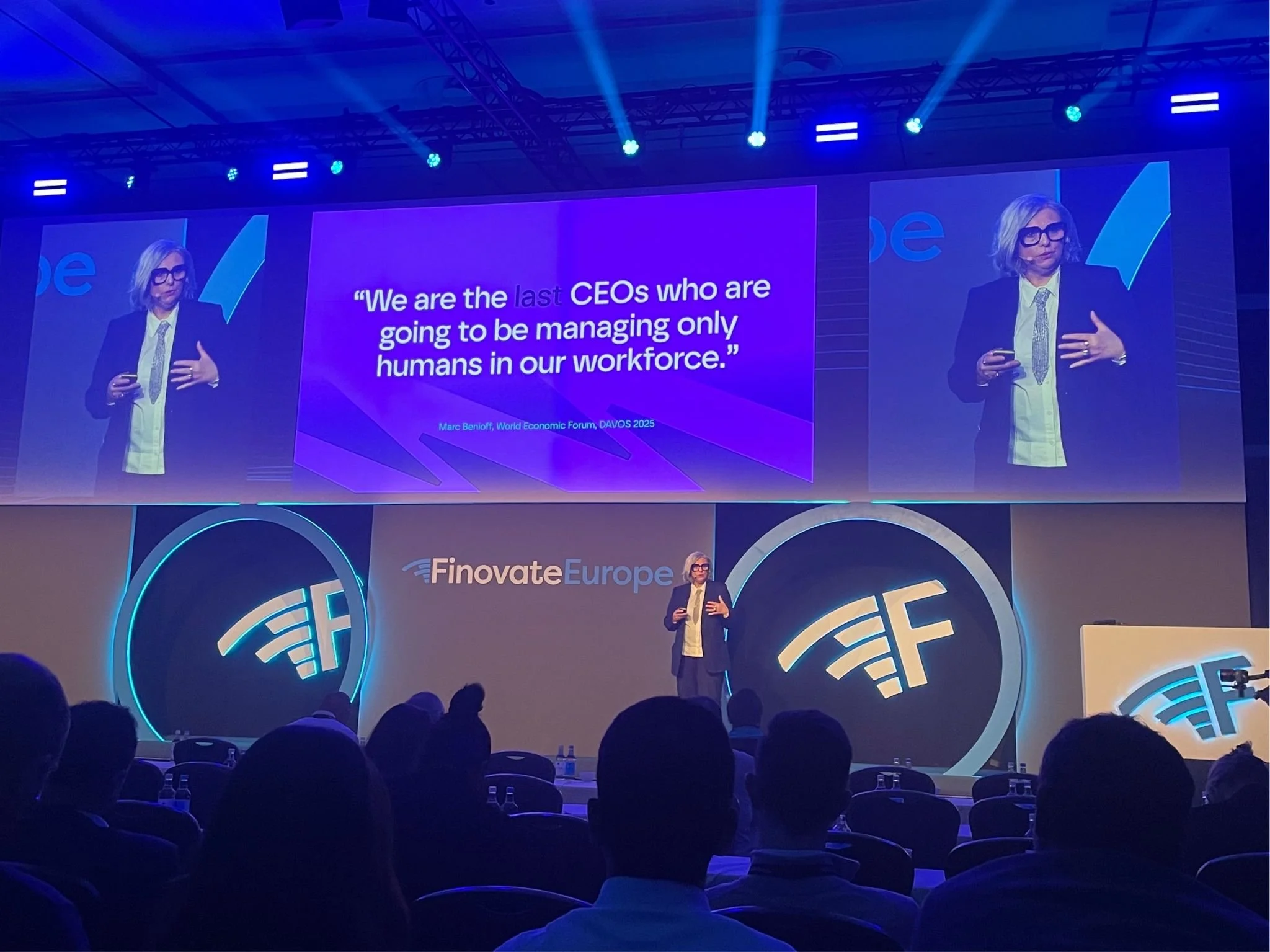
Tracey Fellows keynote address on AI.
Talks, Demos & The Atmosphere
The talks were genuinely inspiring — industry leaders shared honest insights about compliance, data, and innovation. Even as an outsider, I found it energising to hear from people who’ve built products that shape how billions transact every day.
The demos were the highlight: fast-paced, seven-minute pitches where startups showed real products live on stage. It was a great way to see what’s actually being built — no fluff, no theory. For anyone in fintech, it’s the perfect window into the competitive edge of the industry.
There were also free giveaways, company booths, and even book signings where you could meet authors and founders. Those little things made it feel like a celebration of fintech culture — not just another corporate event.
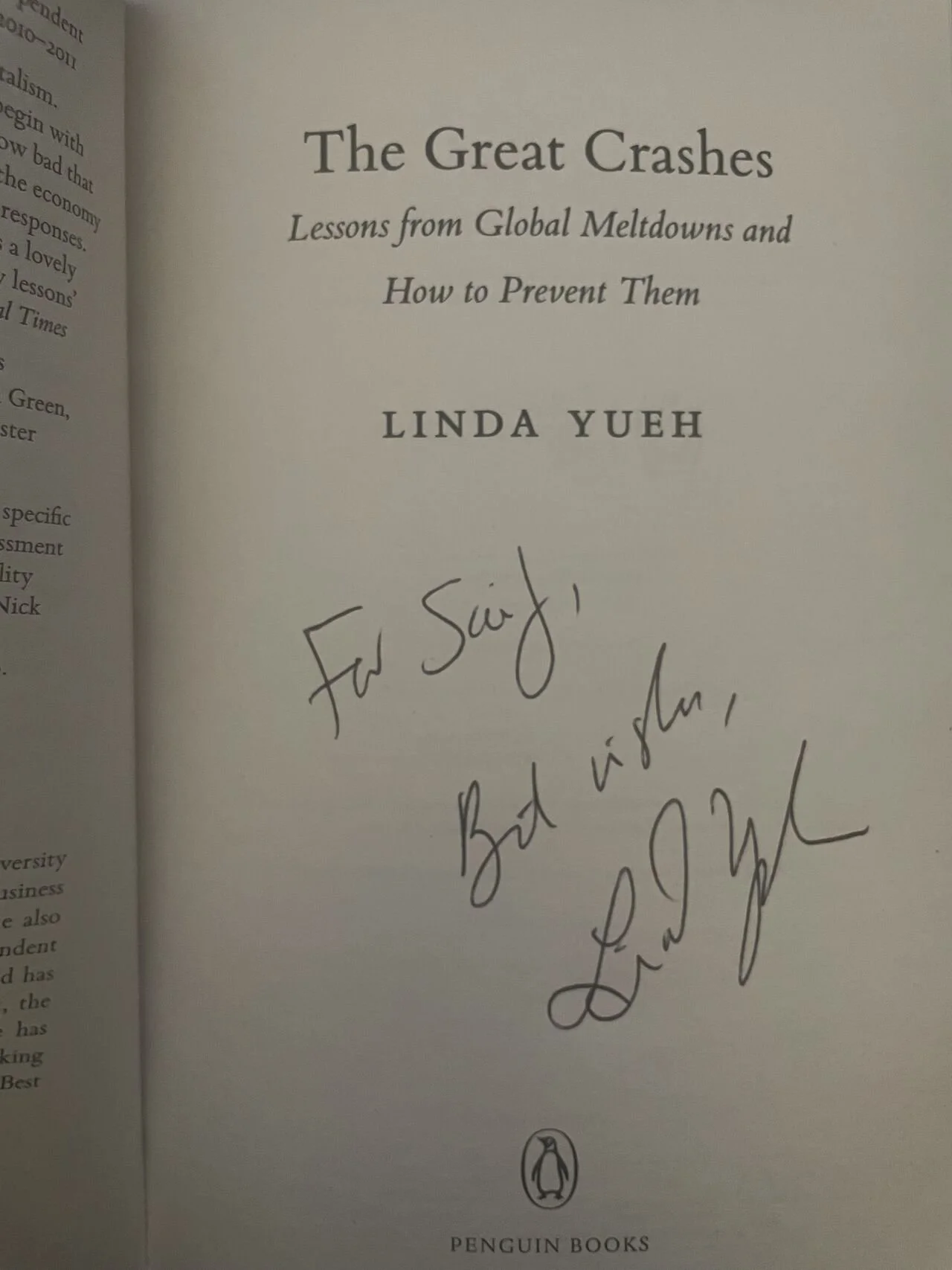
Signed after Linda Yueh’s keynote address on the escalation of geoplotical risk.
Personal Takeaways
I met a few brilliant builders and had some really valuable conversations about learning curves, building small, and failing forward.
Those chats made the event worthwhile. They also gave me the push to start vibe-coding at home — experimenting with small AI systems and automations to learn by doing.
Value for money?
For me: once, yes. Not again soon.
It was a valuable snapshot of where the industry is going, but unless you’re selling, fundraising, or deeply embedded in fintech, it’s not a repeat investment.
Exposure to new ideas⭐⭐⭐⭐
Networking quality⭐⭐⭐
Practical learning⭐⭐⭐⭐
ROI for inspiration⭐⭐⭐⭐⭐
If you work in banking or finance, or your company can sponsor your ticket, it’s worth every pound.
But if you’re more of an observer or a sponge, one visit is enough to see the landscape, absorb the energy, and walk away inspired.
Closing Reflection
Finovate reminded me that the real revolution in finance isn’t about new apps — it’s about agents: intelligent systems that learn, reason, and execute.
And sometimes, paying to watch that future unfold once is enough to motivate you to start building your own version of it.