Journal
Shorter, in-the-moment notes. This is where I post:
Individuals - ideas from shapers and thinkers as public blueprints.
Weekly Connections – a summary of what I learnt each week.
Conference Notes – takeaways from events in space, finance, and technology
Benjamin Franklin and the Proof That One Lifetime Is Enough
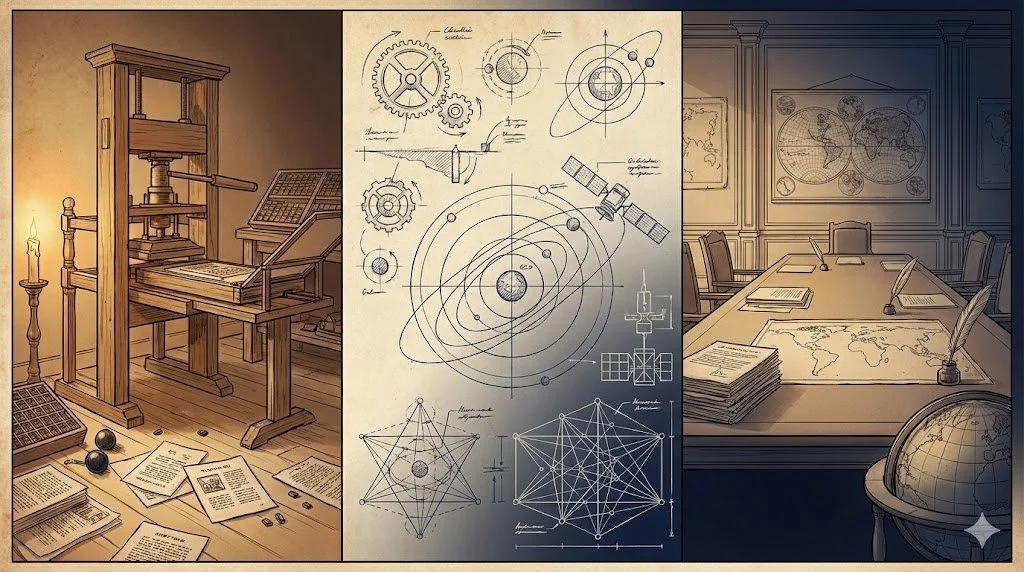
I didn't know much about Benjamin Franklin before watching the Ken Burns documentary. I knew he was on the $100 bill. The kite and the key. Maybe that he signed the Declaration of Independence. But watching his life unfold, one question kept hitting me: How did one man do this much in a single lifetime? Printer. Scientist. Diplomat. Three completely different careers, each one world-class. No formal degree. No aristocratic title. Just a printing press, books, and an obsession with not wasting time. At 27, I've just walked away from a stable career at KPMG to build AION—a risk engine for the space economy. I'm racing to finish Module 2, hoping I'm not too late to land at Relm when the employment cycle restarts in January. I need proof that you can stage a great life from nothing. Franklin is that proof. Here's what he taught me about Business → Architect → Statesman.
I've always been curious about Benjamin Franklin, but for most of my life, I only knew the caricature.
To me, he was the guy on the $100 bill. The kite and the key. Maybe that he signed the Declaration of Independence. That was the extent of it.
Recently, I've been systematically studying great thinkers as part of my own curriculum. Franklin was simply next on the list. But after watching the Ken Burns documentary and reading Walter Isaacson's biography, that caricature broke completely.
What emerged instead was a man who lived three full lives in one body:
The Printer — the grinder, the businessman, the builder of networks.
The Scientist — the researcher who retired early to question nature.
The Diplomat — the statesman who shaped nations without a crown.
No formal degree. No aristocratic title. Just a printing press and an obsession with reading.
And watching his life unfold, one question kept hitting me:
How did one man do this much in a single lifetime?
I’ve been watching these Ken Burns documentaries back-to-back lately — Jefferson, Washington, Da Vinci, now Franklin. Not for entertainment. For orientation. I’m 27, I’ve just walked away from a stable career, and I’m trying to rebuild my trajectory around something I actually respect.
Franklin matters to me because he makes the long game feel legitimate. Not “believe in yourself” legitimate — structurally legitimate.
A staged life. Business first. Then science. Then service at a higher level. And somehow it still adds up, centuries later.
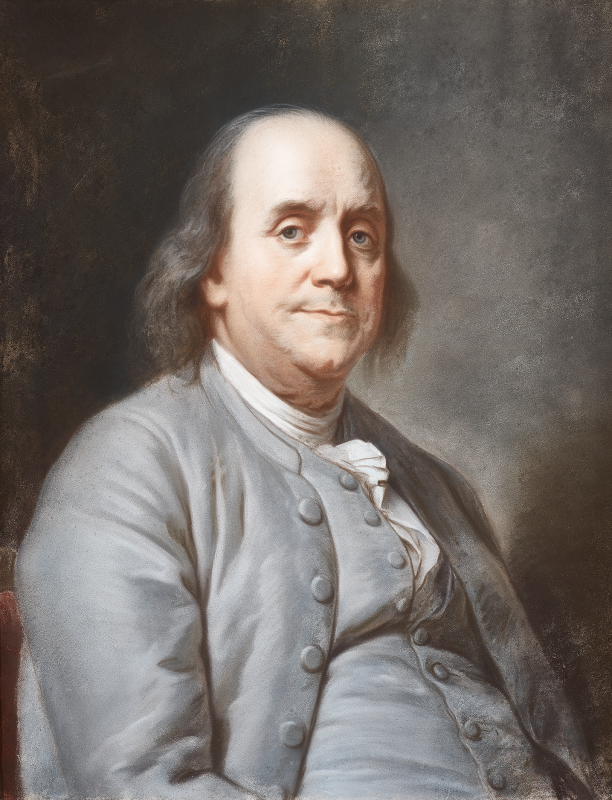
Benjamin Franklin at 77
Life 1: The Print Shop (The Grind)
The first thing about Franklin that hits me is how early he started working.
By age 10, he's earning. By his teens, he's in the printing world. He becomes a printer, then runs his own shop, then a newspaper. He writes, edits, sells, prints, delivers. There's no romance here. It's just grind.
But the print shop becomes his first laboratory.
He learns:
How information spreads
How people actually behave (not how they say they behave)
How to sell an idea, not just have one
From that foundation, he spins out the Junto (his leverage network), the first public library, a fire department, a hospital, and a college that eventually becomes the University of Pennsylvania.
The business phase isn't the end goal. It's the training ground. It teaches him how value, people, and systems work in the real world.
My Print Shop
I'm in my print shop phase right now. And honestly? It's terrifying.
I left what I call a "zombie job" at KPMG—reports no one read, work that didn't compound, just monthly paychecks and the slow realization I was sleepwalking—to build in the space economy.
On paper, this makes no sense. I have no engineering degree. I have no formal coding background. I'm entering one of the most technical industries on earth with a computer and an idea.
My print shop isn't about ink stains. It's about credibility.
Right now, that looks like: late nights in Cursor, shipping modules, breaking things, fixing them, learning fast. I'm building AION using AI-assisted development—not to pretend I'm a senior engineer, but to accelerate the build-test loop so I can ship something real.
I'm 90% through Module 2 of 4. It's December 2025. The employment cycle restarts in January. I'm racing to finish the MVP before that window closes.
AION isn't just a product. It's proof-of-work. It's the first thing I can point to and say: I didn't just read about the space economy—I built a tool for it.
Franklin didn't get to be a scientist until his printing business succeeded. I don't get to the research phase until this phase works.
That's Stage 1. Business phase. Apprentice phase. Proving I'm not just talk.
The Missing Junto
Franklin famously created the Junto—a club of mutual improvement where tradesmen and thinkers met to discuss ideas. It was his leverage network.
I look at my life right now, and I have to admit: I don't have a Junto yet.
I have friends. I have foundations. But a true Junto requires mutual professional respect, and right now, I'm still earning mine. When you quit a big firm to go solo, you lose your borrowed credibility. You're just a guy with an idea until you prove otherwise.
I've realized that the Junto doesn't come first. The work comes first. The people appear once you start making a name for yourself.
I'm building in silence right now so that eventually, I can build a table worth sitting at.
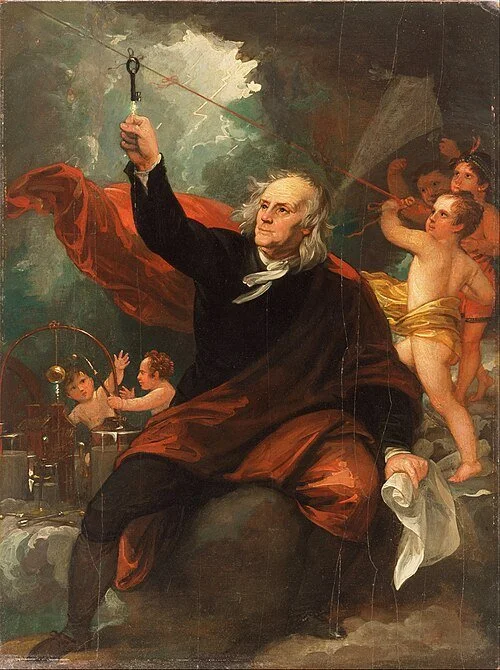
Benjamin Franklin Drawing Electricity from the Sky (Benjamin West)
Life 2: The Architect (The Design Phase)
Franklin steps back from business around 42 and pivots into science.
Not because he's bored. Because he's built enough independence to follow curiosity without asking permission.
Electricity. Lightning rods. Bifocals. The Franklin stove. Ocean currents. Weather patterns.
His loop is simple:
Experiment → Observe → Publish → Iterate
He doesn't hoard the work. He doesn't try to monetize every insight. He shares. He compounds usefulness and reputation, not just money.
That's the move I'm paying attention to: not "become a scientist", but earn enough freedom to do deeper work.
My Version: The Architect
I don't think my Life 2 looks like Franklin's laboratory phase.
Once I've done well in the space industry—once I've built credibility, real expertise, and some independence—I want to shift from building individual products to designing the systems those products sit inside.
This is the Architect phase: work that's less about features and more about frameworks.
It looks like:
Deeper work on space economics, orbital risk, and governance (what actually makes orbital infrastructure investable and insurable)
Building institutions: research centres, study programmes, small think-tank style outputs that translate complexity into decisions
Designing capacity where it doesn't exist yet—especially for developing economies trying to enter the space race
Taking what I learn from space risk systems and applying the same thinking to other domains where incentives and uncertainty collide
Why "Architect" instead of "Scientist"?
Franklin's frontier was physics. Mine is systems design.
The space economy isn't just a technical problem—it's an institutional one. How do you price risk when there's no claims history? How do you convince capital markets to fund orbital infrastructure? How do you help a developing nation build space capability without importing broken incentives?
Those aren't engineering questions. They're architecture questions: designing the frameworks, governance structures, and economic models that make the technical work sustainable.
Franklin's "science" was electricity. Mine is systems design at scale.
Not just "here's a better underwriting engine", but:
"Here's how a country should think about space risk"
"Here's the institutional architecture that makes orbital infrastructure viable"
"Here's how you avoid importing the wrong incentives into a frontier industry"
This is also where philanthropy begins for me—but not as passive giving. More like building public infrastructure for thought: frameworks people can use, institutions that outlast a single product cycle.
That's where I'd like to be in my 40s.
But I can't skip the line. Franklin only got to play with lightning because he spent twenty years sweating over a printing press.
I only get to be an Architect if the Business phase works.
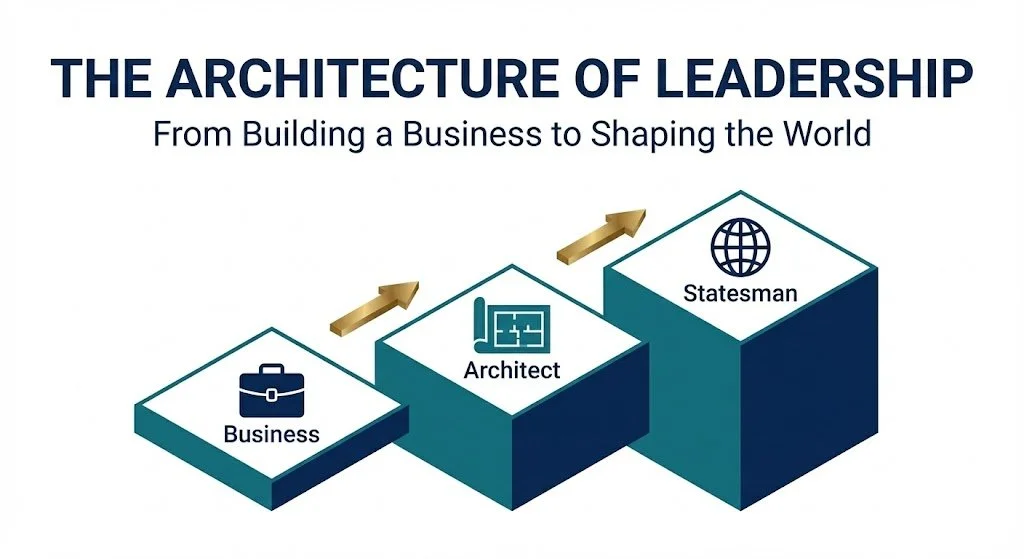
Life 3: The Statesman (The Duty)
Then there's the third life.
Franklin in London and Paris, surrounded by aristocrats and ministers. No crown. No army. But real influence.
He becomes a translator between worlds:
Colonies and empire
Enlightenment philosophy and rough political reality
Idealistic declarations and brutal incentives
He doesn't rule. But he shapes the rules.
My Version: The Statesman
This is the long game.
If Life 1 is building credibility in the space economy, and Life 2 is designing frameworks and institutions that actually work, then Life 3 is using that accumulated weight to help steer bigger systems.
Not as a consultant selling slide decks—but as someone who has built things, tested them, learned where reality pushes back, and can speak to both the technical layer and the institutional layer.
I'd like to contribute to Pakistan's space programme one day. And to other countries trying to build capability without repeating the same mistakes—not just technically, but economically and institutionally.
Concretely, that might look like:
Helping design national space policy frameworks
Advising on risk management and insurance structures for orbital assets
Building capacity programmes for space agencies in developing economies
Contributing to international governance discussions on orbital debris, liability, and coordination
This is the philosopher-king phase without the throne: not ruling, but helping shape the systems other people operate inside.
And Franklin's point—the point I keep coming back to—is that this can be staged:
Business → Architect → Statesman.
Each phase builds leverage for the next. That's the blueprint I'm aiming at.
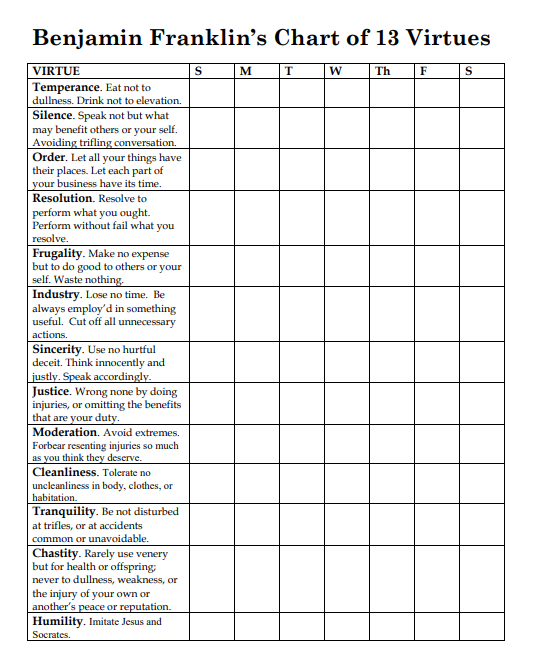
Franklin’s 13 Virtues
Franklin's Virtues (And Where I'm Failing)
Underneath all of this, Franklin had a personal operating system: the 13 virtues he tracked in a notebook.
Temperance. Silence. Order. Resolution. Frugality. Industry. Sincerity. Justice. Moderation. Cleanliness. Tranquillity. Chastity. Humility.
What I like about it is that it isn't performative. He tracked them because he struggled with them. He wasn't writing from a pedestal—he was logging the work.
I feel that same friction every week.
Resolution: I tell myself I'll wake up at 7:00 and start the day properly. I wake up at 8:00.
Industry: I tell myself I'll read faster and deeper. I'm still averaging about a book a month.
Frugality: I tell myself I'll be more deliberate while I'm building. Then London happens—and the numbers move whether you like it or not.
It frustrates me because it doesn't feel like a small thing. When you've taken a risk, consistency becomes the whole game. Waking up late isn't "a lifestyle choice". It's time you don't get back.
But Franklin's real lesson is this: character is a design problem, not an identity.
You don't fail once and decide you're broken. You mark the X on the chart, then try to keep the column clean tomorrow.
For me, four of his principles feel like the core operating system:
Frugality — spend on things that compound
Truth/Sincerity — don't bullshit yourself
Industry — do the work for a long time
Kindness/Justice — don't trade decency for ambition
I'm 27. By Franklin's standards, I'm behind. He had already built momentum by this age.
I can't change the earlier chapters. I made choices that didn't compound the way I wish they had—a Law and History degree, a corporate job that taught me process but not systems thinking.
My friends and family think I'm crazy for leaving. And until I prove this risk paid off—until AION works, until Stage 1 is complete—they're right to think that.
But here's the difference: I'm awake now.
I know I'm behind. But I also know I have time to fix it.
The only thing that counts from here is what I build next.

Why This Matters to Me Right Now
It's easy to look at Franklin and think: different era, different rules, different world.
But he's proof of three things I genuinely need to believe right now:
1. Formal education is optional. Self-education isn't.
Franklin built himself out of books, work, and observation. I have access to more knowledge than he ever did—and now AI tools that make learning and building faster. The barrier isn't access. It's discipline.
2. You don't have to pick one identity for life.
Printer → scientist → diplomat. Three serious lives, one person. I don't need to be "just" one thing forever. I can stage it: build first, then design bigger systems, then serve at a higher level.
3. A life can be engineered in phases.
Each phase builds leverage for the next. That's the part that calms me down when I start spiralling about timelines.
Right now, I'm in the grind: building AION, finishing modules, tightening the work so it's real enough to stand behind when I speak to people in the industry.
I want it ready before the year turns—not because it's a deadline, but because I'm tired of having ambition without receipts.
Franklin's reminder is simple: this is Stage 1. It's not meant to feel like the end. It's meant to build the base.
If I do this phase properly, I unlock the next one.
Nothing is guaranteed—but the structure is sound.
The Blueprint
Franklin did all of this with a print shop and candlelight.
I have access to tools he couldn't imagine, and a frontier industry that still feels early enough to shape.
So the question I keep coming back to isn't "what would Franklin do?" It's simpler:
Am I doing the work that earns the next stage?
I'm in Life 1—the print shop phase—trying to make something real enough that it buys me the freedom to go deeper later.
The Architect phase and the Statesman phase can wait.
The only job right now is to make the press run.
Further Reading & Sources:
Ken Burns, Benjamin Franklin (PBS Documentary)
Walter Isaacson, Benjamin Franklin: An American Life
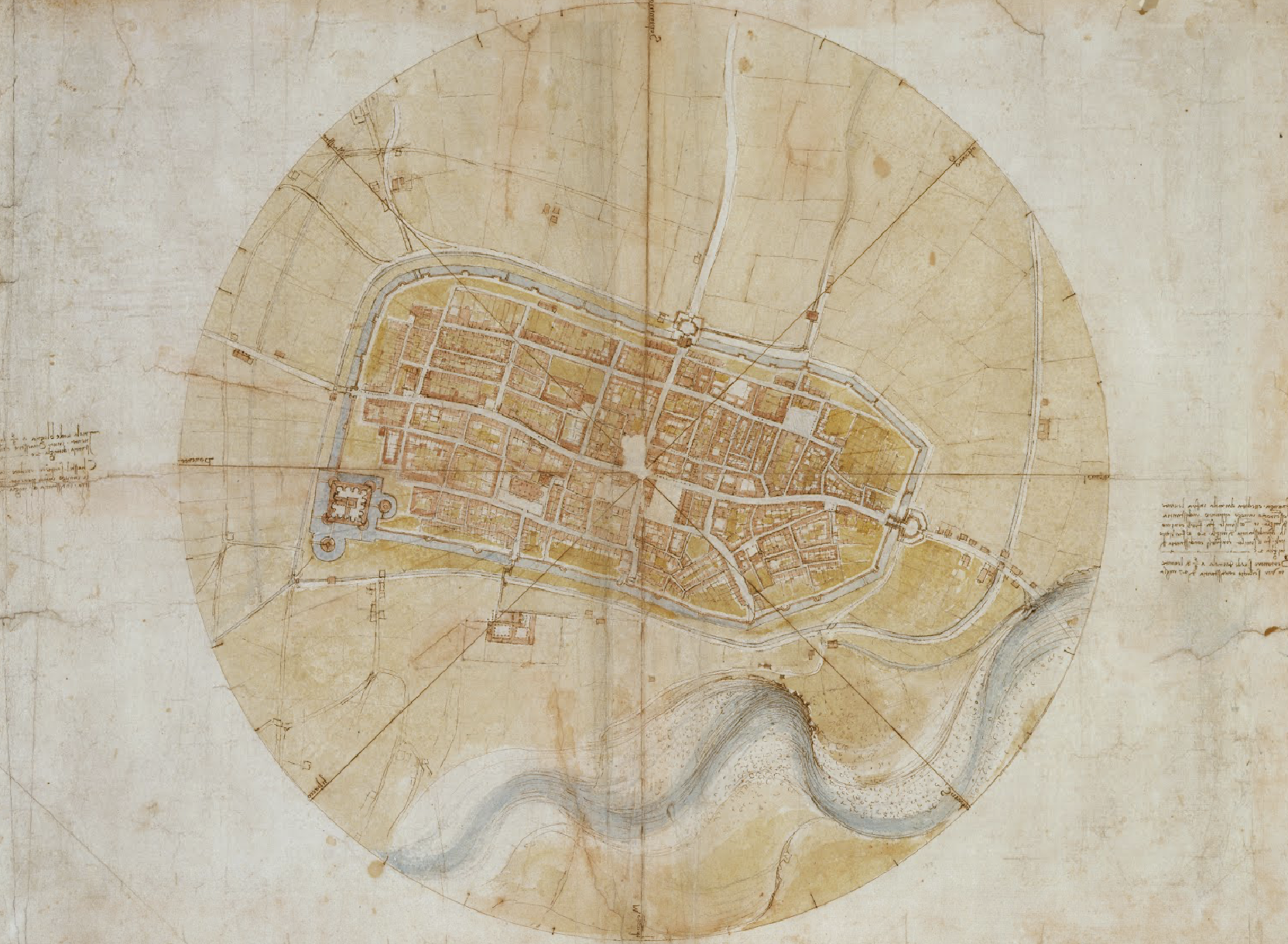
My Vitruvian Man: Learning from Leonardo in the Age of AI
Leonardo da Vinci wasn't just an artist—he was a systems builder who proved outsider education, visual thinking, and demons-as-fuel could reshape reality. Here's what his life taught me about building at the frontier of space and AI.
What Leonardo da Vinci Taught Me About Seeing Systems
I've always been curious about Leonardo da Vinci, but for most of my life, I only knew the caricature.
To me, he was the artist who painted the Mona Lisa. Or, if I'm being honest, I knew him as the character in Assassin's Creed who helped Ezio—the eccentric inventor who gave you the flying machine and the hidden blade.
That was the extent of it.
Recently, I've been studying great thinkers as part of my own curriculum. Leonardo was next on the list. But after watching the Ken Burns documentary and reading Walter Isaacson's biography, I realised he wasn't just a painter or a plot device in a video game.
He was something more useful: a blueprint.
Not for how to be a genius, that's too vague and unhelpful. But for how to operate in the world. How to question it. How to see systems that don't exist yet. How to teach yourself what no one else can teach you.
What landed hardest, watching the documentary, was this idea:
Leonardo lived as if the universe had given him a duty to question it.
Not just to paint or invent. But to look harder than everyone else. To test what the ancients said against what nature actually did. To keep going long after it became uncomfortable.
And once I saw that pattern in him, I started seeing it everywhere.
Franklin. Einstein. Musk.
The details differ. The centuries differ. But the structure is the same:
Question. Visualise. Build.
In an age where AI is beginning to dominate rote intelligence and logic, Leonardo's approach—curiosity, observation, cross-disciplinary synthesis—feels more relevant than ever.
This post is a dissection of his life, not as a history lesson, but as a set of principles I'm trying to apply to my own path. Because I'm not interested in worshipping great minds. I'm interested in finding the pattern. And then using it.
The Outsider Advantage
The first thing that struck me about Leonardo: he had no formal education, not by choice, but by circumstance.
His father was a notary, part of Florence's professional class. But Leonardo was born out of wedlock, which meant he was legally barred from universities, guilds, and most respectable professions. The system locked him out before he even started.
He learned in Verrocchio's workshop as an artisan; art, sculpture, engineering, stagecraft, all mixed together. No rigid curriculum. No gatekeepers. Just observation and the real work of making things.
And instead of treating this as a limitation, he turned it into method.
He read the ancients later in life, but he didn't worship them. When Aristotle said water flows a certain way, Leonardo built channels and watched. When the texts claimed the body worked a certain way, he dissected cadavers and drew what was actually there.
He was careful, of course. He understood the constraints of religion and power. He framed his observations in ways that wouldn't get him labelled a heretic. But underneath, his approach was radical:
Nature is the primary text. Everything else is commentary.
And through this approach, he proved something that still matters: you can understand anything in existence through observation of nature and apply it to human challenges. You don't need permission from the system. You can question the foundations laid by past thinkers and still discover new ideas, even in a world that claims everything important has already been thought.
I see the modern version of this now.
I have a law and history degree. No formal STEM education. No engineering background. On paper, I shouldn't be building AI-driven risk systems for space missions.
But here's what's changed: in 2025, you can do anything you want to do, as long as there's a real problem and you're learning to solve it. That's where value lies. Not in credentials. Not in gatekeeping. In whether you can actually build something that works.
That's why I'm taking the risk to leave a stable corporate job and move into the next frontier. Not because I have the "right" background, but because Leonardo proved the pattern:
When you're locked out of the system, you learn to see reality directly. And sometimes, that's the only way to see it clearly.
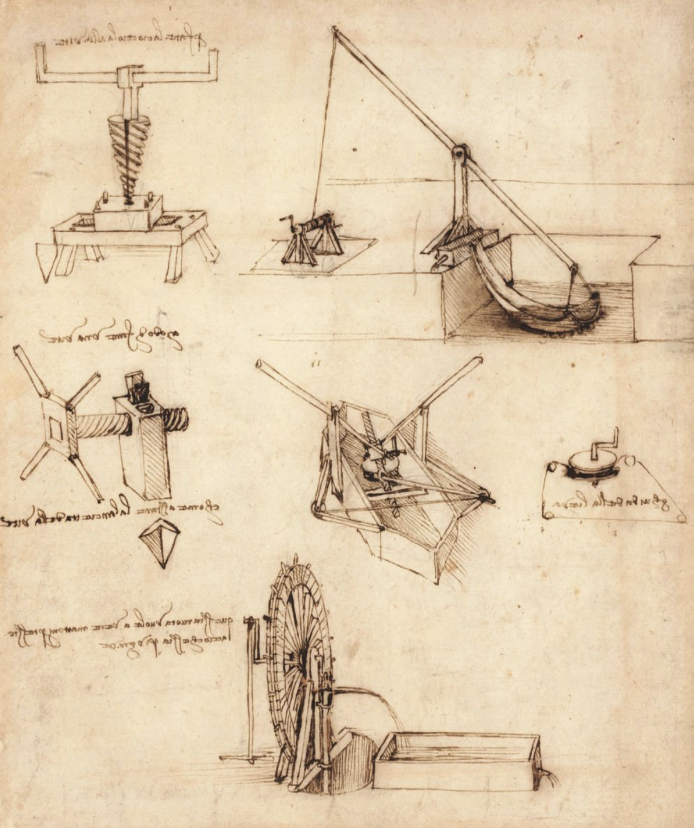
Codex Atlanticus, folio 156 r - Methods for lifting water.
Seeing Systems Before They Exist
Leonardo's notebooks aren't filled with essays or long arguments. They're filled with drawings.
Thousands of them. Machines that wouldn't be built for centuries. Anatomical studies mapping structures no one else had seen. Helicopters, tanks, diving suits, all sketched in precise detail, decades before the technology existed to make them real.
He wasn't just recording observations. He was visualising how systems would behave before they existed.
The Vitruvian Man is the perfect example. It started as ancient Roman text about human proportions. But Leonardo didn't just read Vitruvius and move on. He rebuilt it in his own visual language, circle and square, body and cosmos. The drawing became a way of seeing the relationship between human form and universal structure, not just describing it.
Walter Isaacson calls people like this "visual seers." Not just analytical. Not just intelligent. But able to hold entire systems in their mind's eye and watch them move.
I recognise this pattern in others: Musk, Einstein, Franklin. They don't solve problems sequentially. They see the whole structure first, how pieces fit together, the feedback loops, the constraints and then they build toward that vision.
I'm starting to notice the same shift in how I think.
Constantly making notes and asking questions when reading or watching something when previously no action was taken and the experience was not incorporated effectively into my mind. When designing AION's risk engine, I have to see beyond Module 1 to make sure the entire system is modular and flows from one to another in logic and design.
The pattern is: moving from understanding ideas to seeing systems.
And this matters more now than ever.
If AI can handle the rote logic, the "what does this paper say?" layer, then the real edge shifts to questions machines can't answer yet:
What systems can you imagine that don't exist?
What questions should we be asking that nobody else is?
What needs to be built that no model can generate for you?
Leonardo did this with charcoal and ink. The tools change, but the principle doesn't.
Because you cannot build what you cannot clearly see. And in frontiers like space and AI, the answers haven't been written yet.
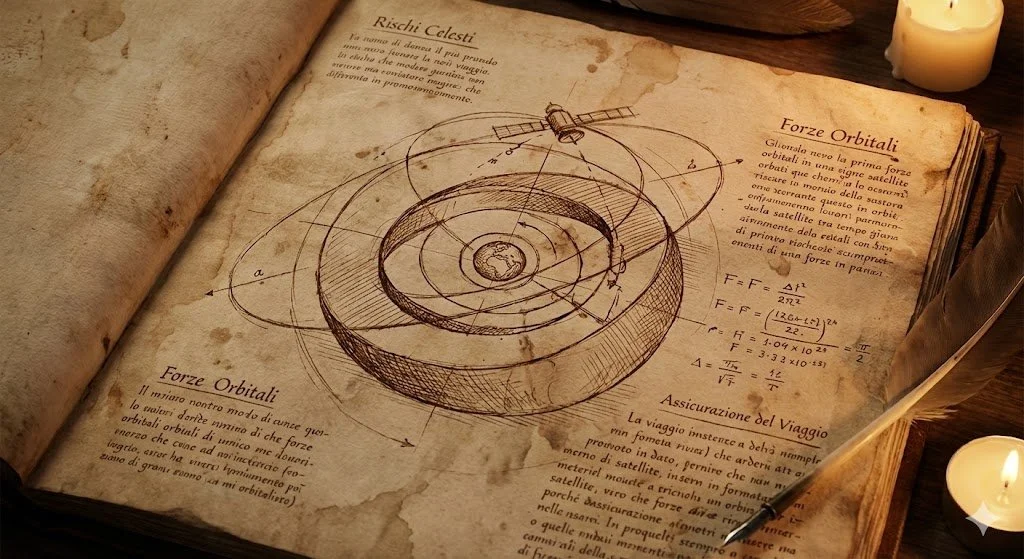
Modern system sketched in Leonardo's style — bridging 15th century and 2025
Demons as Fuel
There's a darker pattern Walter Isaacson points out in his biographies of both Leonardo and Musk.
Great thinkers usually have demons.
For Leonardo, it was illegitimacy, abandonment, the feeling of being an eternal misfit in a structured society. For Musk, it was a brutal childhood. Isaacson argues these demons aren't just unfortunate side effects, they're often the engine. They drive the restlessness. They create the need to prove something that can never quite be proven.
I have to be honest about this: I don't think you can become a high-level creator without some damage.
If I didn't have my own childhood trauma, I'd probably be part of the comfortable 95%. I would've taken the promotion at KPMG. I'd be content with the stable salary, the weekends off, the quiet life.
But I'm not built that way.
My demons are fuel. There's a part of me constantly at war, needing to prove to myself and to the world that I can build something that matters. That I'm not just here to exist, but to shape the system.
This is dangerous energy. It comes with a cost. It strains mental health. It puts pressure on relationships. It makes it hard to just "be."
I'm fortunate to have a partner who understands the mission. But I've also accepted that if you want to sit in the same category as the historic greats, you have to live with a certain level of internal turbulence. Your mind won't always be peaceful. And peace rarely leads to breakthrough.
The goal isn't to exorcise the demons completely, that would kill the drive.
The goal is to harness them. To point that obsessive energy at a problem like space risk or systems architecture, rather than letting it consume you.
Leonardo lived with his demons his entire life. They drove him to dissect thirty corpses in cold rooms. To spend years on a single painting. To design machines no one would build for centuries.
He didn't eliminate the friction. He converted it into work.
That's the pattern I'm learning to follow.
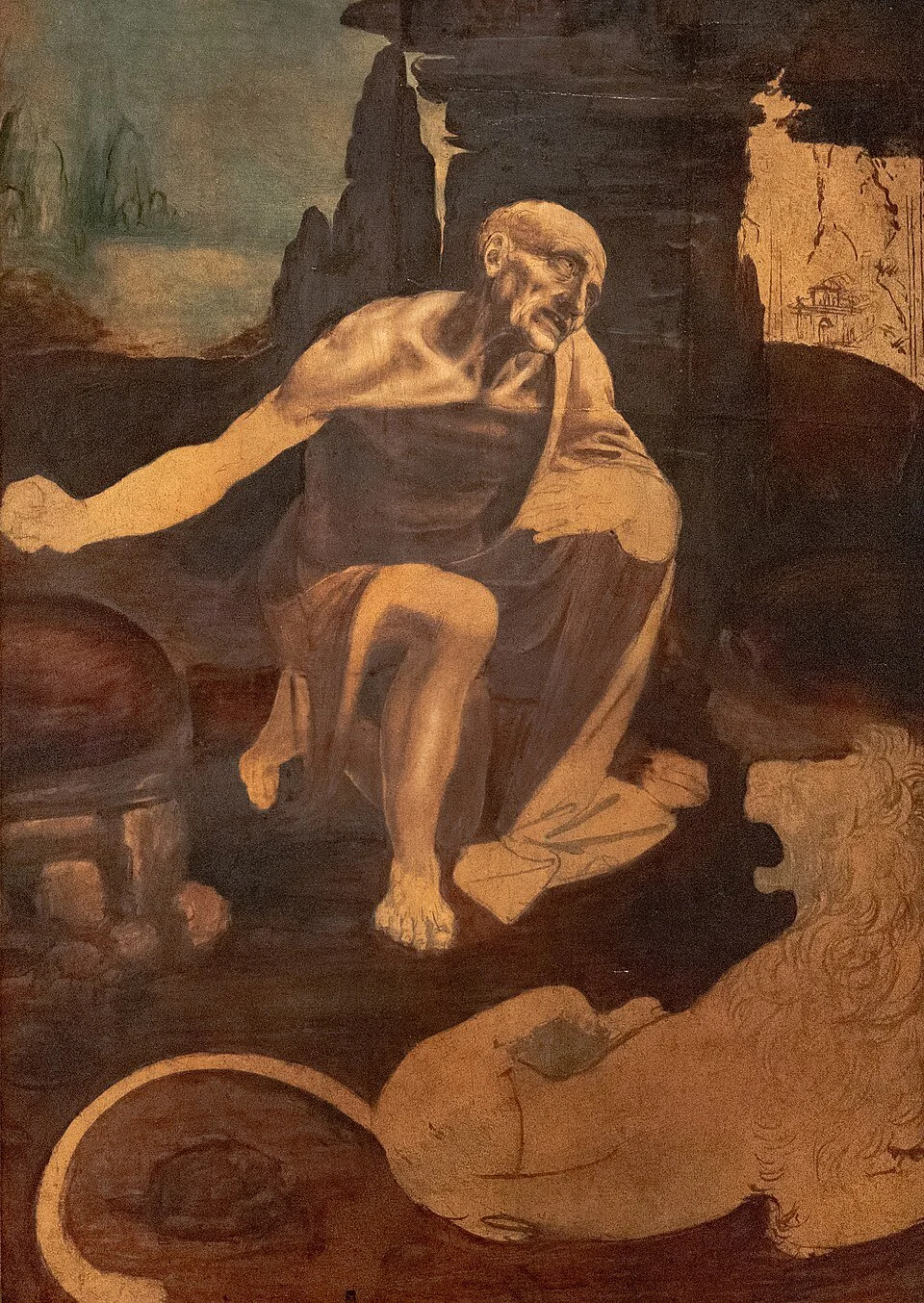
Leonardo da Vinci St. Jerome in the Wilderness (1480-1490)
My Vitruvian Man
If demons are the engine, then the question becomes: what vehicle are you building around them?
Leonardo answered that in his own way with the Vitruvian Man. It wasn't just a clever drawing. It was a statement about proportion—about how a human being should fit inside the circle of the cosmos and the square of human order.
I've started thinking in those terms for my own life.
If I know I'm wired for obsession, I can't just "see what happens" over the next decade. I need structure that can hold that energy without cracking.
So here's the question I'm trying to answer: What is the Vitruvian Man of my life?
It stands at the intersection of two worlds:
The Circle: The Cosmos
Space, uncertainty, nature. The questions we haven't answered yet. The expanding edge where the rules are still being written.
The Square: Human Systems
Law, markets, institutions, power. The structures we've built to organize complexity and behavior.
I don't want to live only in one or the other. If you disappear into the circle, you become a detached theorist. If you stay trapped in the square, you become a bureaucrat. The whole point is to stand in the middle and move between them.
I've started mapping my own limbs:
Head — The Philosopher King
This is the duty to question. Reading the ancients not to worship them, but to steal their questions and test them against 2025. Understanding why before jumping to how. Accessing wisdom from Plato and Aristotle the past thinkers and applying it to the future. If this part wastes away I drift into building clever toys with no spine.
Left Hand — The Builder (My dominant hand)
I'm left-handed, so this is the building hand. Software Development, products and new systems. Taking vague ideas about space risk and turning them into something an underwriter can actually click on. This is where "visual seer" has to become "working product."
Right Hand — Law, History, and Persuasion
The other hand is context and leadership. Understanding how power, capital, and decisions move through institutions. Being able to explain, persuade, and pull people into a vision. You can't shift a system if you don't understand its history or speak the language of the people inside it.
The Body — Vitality and Presence
The mind cannot function without the vessel. This is about physical discipline—gym, golf, diet, looking after the machine that carries the brain around. Not for vanity, but for projection. To lead, you must project energy and confidence. If the body is weak, the system fails.
The Feet — Capital and Grounding
Both feet planted in reality. Finance, risk management, capital allocation. Making sure I'm not building a grand theory while my real life collapses. You can have your head in the cosmos, but your feet must be planted on a balance sheet.
Around the figure, three laws that hold the structure together:
Temperance — No excess. No self-destruction. Demons as fuel, not fire.
Lifelong Learning — Apprentice → Master → Philanthropist.
Love and Respect for Others — Not becoming so obsessed with systems that I forget humans. Mentorship, teaching, building things that actually help.
This is what I'm building toward: a polymath life that connects across disciplines, stays physically and mentally sharp, and has enough moral weight to be worth taking seriously.
Most careers force you to slice yourself into a single sliver of this diagram. You're just a lawyer. Just an engineer. Just a consultant.
But the lesson I'm taking from Leonardo is that true insight, the kind that shifts paradigms, happens when you refuse to slice yourself up.
It happens when you let the engineering inform the philosophy, and the history inform the code, and the physical vitality power the whole structure. When you stand at the intersection and see patterns nobody else can see because they're trapped inside a single domain.
That's the architecture I'm trying to build. Not a career. A system capable of operating at the intersection of cosmos and institutions, asking questions nobody else is asking, then building the tools to answer them.
It's not finished. It's not perfect. But it's starting to take shape.
And that's the point Leonardo taught me: you don't wait until you're ready to draw the diagram. You draw it while you're becoming it.
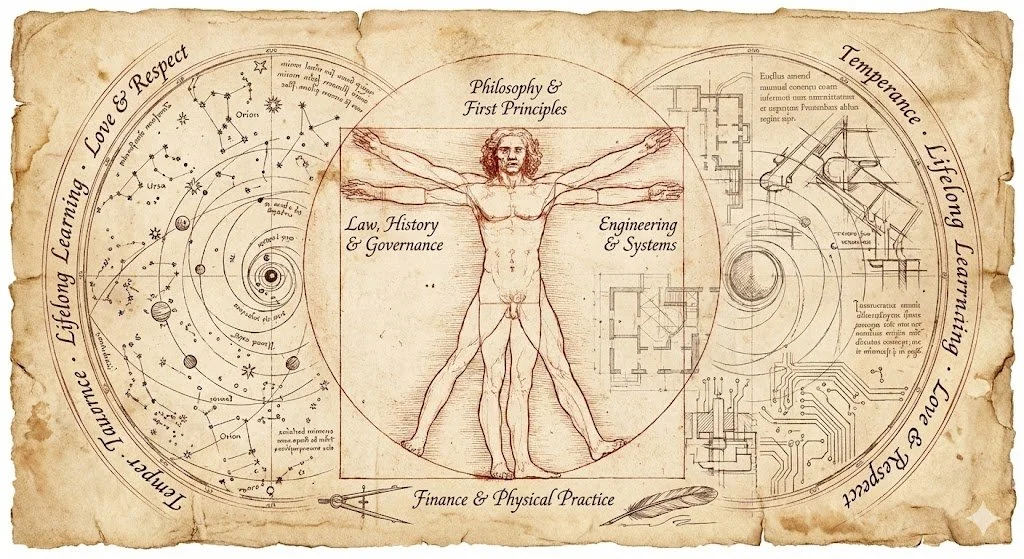
My Vitruvian Man
The Duty to Question the Universe
Leonardo believed his duty, given by the universe, was to question it.
Not to accept what the ancients said. Not to settle for approximations. But to look harder, sketch what he saw, test it against reality, and keep going even when it became uncomfortable.
I've realized I have a version of that same duty.
Not to paint the Mona Lisa or design flying machines. But to build tools and models that help us operate in uncertain, high-stakes environments, for the time being that is the Space Economy but there will always be areas where the answers haven't been written yet that I can diverge into.
To do that well, I need to become the kind of person who can hold law, history, engineering, finance, and philosophy in one mind. Who can visualize entire systems before they exist. Who can ask the right questions, then build the answers.
I'm not there yet. But I'm starting to see the pattern.
And in 2025, in an age where AI can handle the rote logic and the surface-level analysis, the real edge is exactly what Leonardo proved five centuries ago:
The capacity to see what doesn't exist. To question what everyone else accepts. To build the systems that shape reality, not just describe it.
That's the blueprint I took from watching his life.
That's what I'm building toward.

Pillars Of Creation

Weekly Connections #2
This week I moved across Aristotle’s logic, Euclid’s geometry, the night sky, rocketry, and my ongoing AION development. The pattern that emerged was simple: each discipline teaches how structure shapes behaviour. From logical forms to orbital motion to risk modelling, the same system principles appear everywhere.
Logic, Orbits, Propulsion & Building AION
Each week I’m asking myself a simple question:
What new connections did I make across disciplines that could one day create value for others?
This week’s connection:
ancient logic + Euclid + astronomy + rocketry + AI-driven space-risk systems (AION).
They look separate. But the further I go, the more they feel like the same discipline expressed in different languages:
how structure creates behaviour.
The connection
Aristotle → Euclid → the night sky
This week I spent time with:
Aristotle’s Logic II — propositions, forms, syllogisms
Euclid Book I (11–20) — acute/obtuse angles, circles, boundaries
Euclid I.5 — my first full geometric proof
Astronomy exercises — Polaris, stellar motion, Earth’s rotation
Rocketry basics — thrust, mass flow, combustion, nozzle design
Risk architecture (AION Phase 4) — mission phases, near-miss modelling, regulatory bands, and incident integration
On paper, they belong to different centuries.
But the through-line is the same:
A system behaves the way it is built.
Aristotle structures arguments.
Euclid structures space.
Gravity structures motion.
Rocket engines structure energy.
AION structures the risk.
Once you see the pattern, each discipline becomes a mirror for the others.
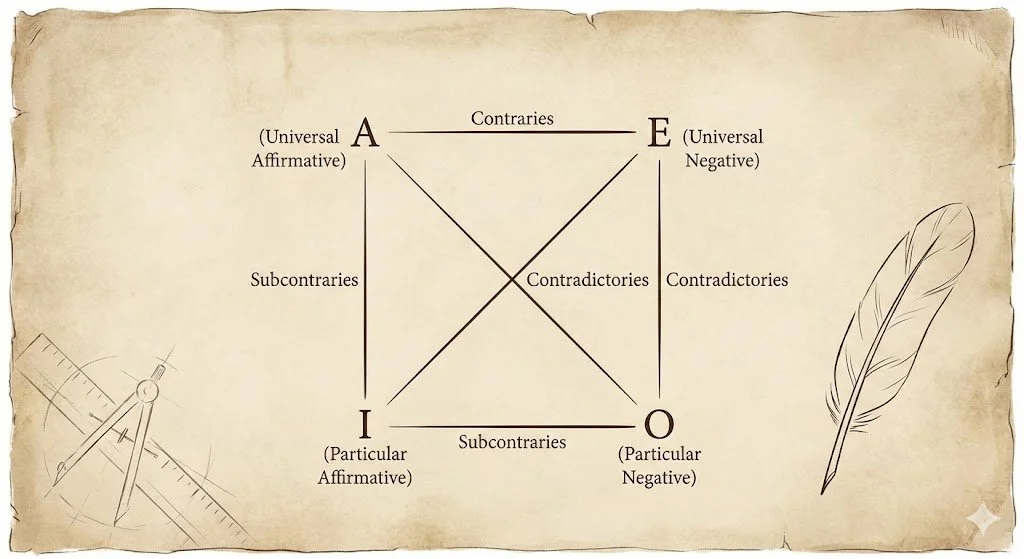
What I studied
Aristotle’s Logic II—the forms beneath thought
I worked through:
Subject / predicate / copula
Quantity (universal/particular)
Quality (affirmative/negative)
The four classical forms: A / E / I / O
When I started writing my own propositions, something clicked.
A: All stars emit light.
E: No planet emits light.
I: Some stars become black holes.
O: Some stars do not collapse into black holes.
The system is simple, but it disciplines the mind.
It forces clarity at the sentence level — the smallest unit of reasoning.
Euclid Book I (11–20)
Copying and drawing the definitions again:
acute/obtuse angles
circles, diameters, boundaries
triangle types
semicircles and centres
Once drawn, the definitions become interfaces, not words.
They give geometry a grammar.
My first full Euclidean proof — I.5
The isosceles triangle proposition forced me into real geometric reasoning:
Equal sides → congruent triangles → equal base angles.
It’s more than a proof.
It’s a pattern:
Start with a given → construct → compare → conclude.
I got stuck on Euclid I.5 for longer than I'd like to admit. The logic was there, but I kept skipping steps...
Astronomy — motion, perception, reference frames
I spent two nights outside observing:
Polaris (near-perfect axis of Earth’s rotation)
The difference in motion between horizon stars and near-pole stars
Atmospheric twinkle
Brightness variations
The illusion of the sky “moving” when it’s Earth rotating
A simple insight:
The world changes depending on what you anchor to.
Polaris gives stillness.
The horizon gives velocity.
Same sky, different reference frame.
That’s also how risk behaves: it depends on where you stand in the system.

Rocketry — thrust, combustion and control
I continued my rocketry lessons and explored propulsion fundamentals:
Newton’s Third Law as the heart of thrust
Mass-flow rate × exhaust velocity
Solid engine structure (nozzle → propellant grain → delay charge → ejection)
Failure modes:
under-performance
nozzle misalignment
failed ejection
One insight stood out:
A rocket’s performance depends less on “how much fuel” and more on how efficiently energy is channelled into direction.
It's simple, but it forces you to think clearly
Flow beats force.
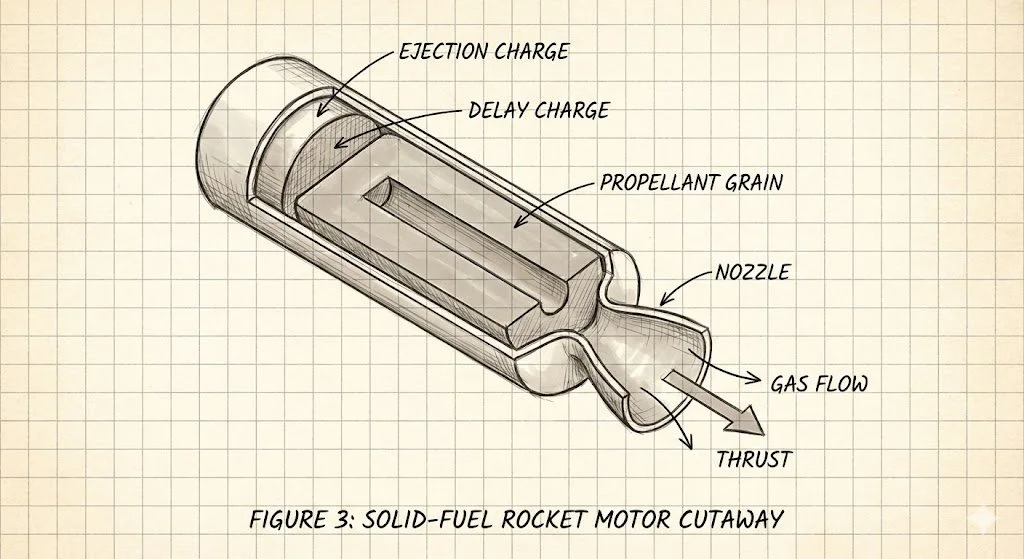
School of Thought — meta-learning connections
Three patterns emerged across all subjects:
Logic → Geometry
Euclid’s proofs are Aristotle’s syllogisms expressed spatially.Geometry → Astronomy
Angles and circles become real when you watch the sky move.Astronomy → Rocketry
Orbits are just curved paths created by gravity and forward velocity.
Every discipline sharpened the others.
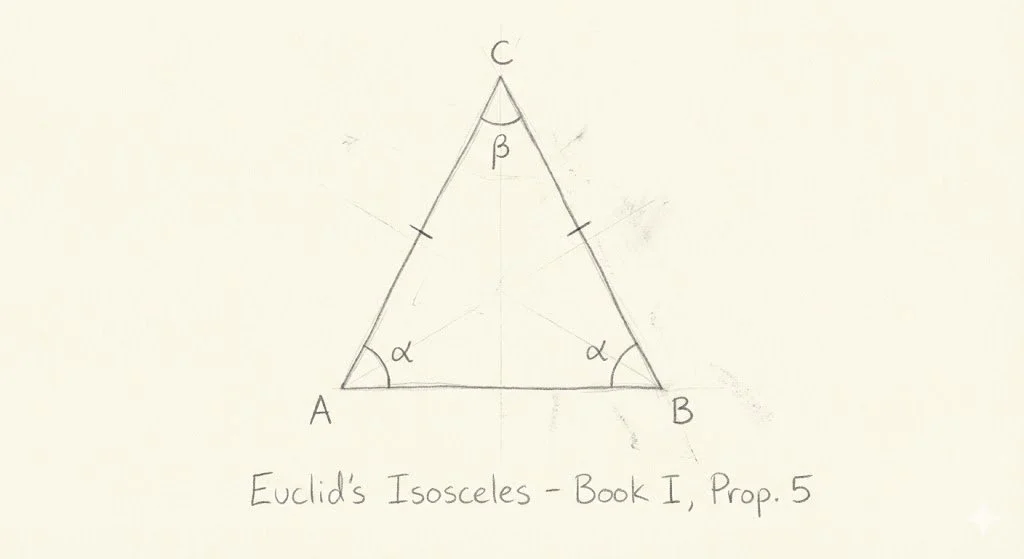
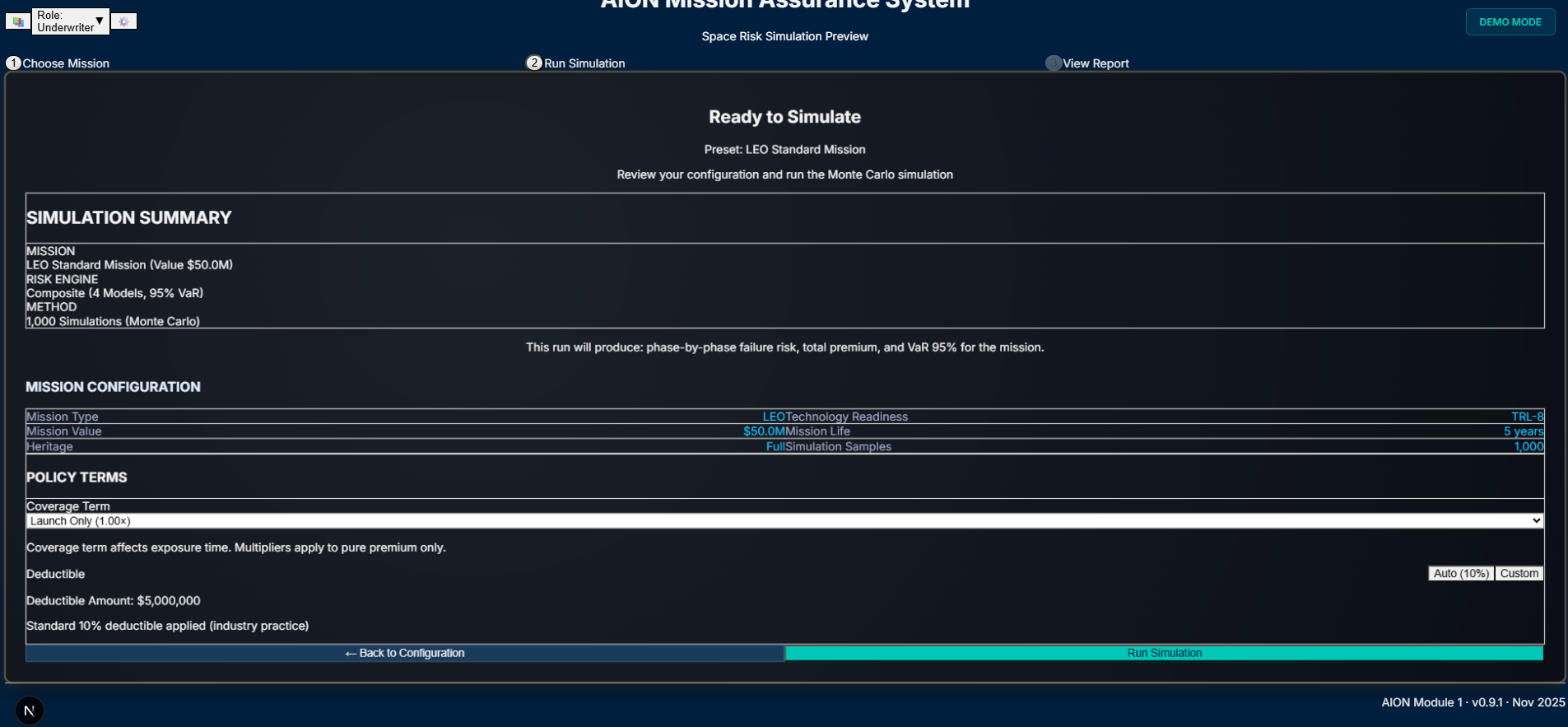
What I built (AION Phases 4 & 5)
This was a major build week.
AION — Phase 4 Sprint D complete, Sprint E underway
Completed the mission timeline, phase detail panel, incident integration, and actuarial breakdowns.
Added model weights, normalised contributions, and the full 4-model ensemble.
Integrated historical incidents and proper UX patterns for underwriters.
Moved into Sprint E with backend integration, AI insight chips, regulatory tab, and export bundles.
The system is starting to feel like a mission-assurance workbench, not just a demo.
The work is technical, but the pattern matches everything above:
assumptions → structure → behaviour
inputs → transformations → outputs
clarity → confidence → better decisions
AION, like Euclid, demands order.
Small insights
Writing Euclid by hand strengthened my focus more than any modern tutorial.
The sky is a moving system, and your perception shifts with your anchor point.
Rocket engines are controlled explosions — a reminder that power without structure is chaos.
Logic isn’t abstract; it’s a container for disciplined thinking.
Risk modelling is just geometry with uncertainty.
What this reveals about the system I’m building
AION will eventually support underwriters making decisions in uncertain, high-stakes environments.
To build that system well, I need:
Aristotle’s clarity
Euclid’s structure
Astronomy’s sense of motion and reference
Rocketry’s respect for forces and constraints
This week made something obvious:
The deeper I go into ancient logic and physical systems, the better I understand the architecture of risk. Which makes me wonder: what other centuries-old frameworks am I missing?
And that’s the real point of these weekly connections —
to build the inner blueprint for the outer system.

Weekly Connections #1
Plato, Alphabets, Logic & Space Risk
Each week I’m asking myself a simple question:
What new connection did I make across disciplines that could one day create value for others?
This week’s connection: ancient philosophy + alphabets + Euclid + AI-driven space-risk systems.
The connection
I finished my first blog post on Plato’s Republic, kept going with Aristotle’s Nicomachean Ethics, completed Lesson 1 of mathematics (Aristotle’s logic + Euclid’s Book I), pushed further into Arabic writing, and read a stack of pieces on modern space politics and AI, including:
US–Middle East space partnerships
Arguments for a Yuma spaceport and a southern launch corridor
The “fallacy of being first” in Moon/Mars exploration
AI for environmental change detection and military C2
Non-Earth imaging and space-to-space surveillance
On paper these look unrelated.
But they’re all training the same muscle: the ability to live and think inside a structure.
Plato and Aristotle → how to order a life and a city.
Euclid → how to order arguments and proofs.
Arabic → how to order sounds and meaning on the page.
Space policy & AI articles → how nations and companies try to order power, risk, and infrastructure in orbit.
Those are exactly the questions I’m trying to solve with AION:
how to design systems for space insurance where logic, incentives, data, and behaviour stay in harmony instead of colliding.
Plato’s tripartite psychology (reason, spirit, appetite) is slowly turning into a design lens for AION architecture.
Euclid is teaching me the logic of structure.
Arabic is teaching me the discipline of symbols.
Space politics is teaching me how those inner structures meet real-world power.
Together, they’re forming an inner blueprint for how to build outer systems.
What I studied
Plato & Ethics
Finished Republic and published my first long-form reflection.
Read Books 7–9 of Aristotle’s Nicomachean Ethics (pleasure, friendship, character).
Mathematics – Lesson 1 (Ancient Method)
Studied Aristotle’s logical structure: terms, propositions, syllogisms.
Copied Euclid’s Definitions, Postulates, and Common Notions by hand – the old Newton/Franklin method.
Wrote my own small “First Principles” page: personal definitions, axioms, and a syllogism.
Completed a first mini-proof (“the whole is greater than the part”) and did basic logic + geometric reasoning exercises.
Arabic (Lessons 2–4)
Now comfortable writing and joining all 28 letters.
Starting to recognise word patterns and write with more flow.
Historical & Intellectual Research
Watched deep dives on Jefferson, Franklin, Washington and added notes into my School of Thought database.
What I researched (space, AI & policy)
AI infra & orchestration maps
Frameworks for how LLMs, agents, retrieval and tools fit together.
Confirmed that AION sits in the workflow/orchestration and risk infra layers, not as “just another app”.
Reinforced the decision to build a Context + Memory Engine and AI Council instead of scattering RAG scripts everywhere.
Agentic systems & token efficiency
Threads on using fewer tokens, more tool calls, and lightweight local models.
Fed directly into the idea of the AI Council as a cost-aware “Code Mode” layer, not a giant prompt that does everything.
Founder/operator reality checks
Lists of what solo builders actually end up doing: product, sales, decks, infra, support.
Helpful as a sanity check: AION can start as a solo “Jarvis-for-space” lab, but real traction will probably need partners and a focused wedge.
20s philosophy & “rock bottom on purpose”
Advice threads about upskilling, embracing discomfort, and rejecting the default 9–5 → 40–year ladder.
Lined up almost eerily with what I’m doing: deliberate reset at 27, rebuilding identity around systems thinking and the space economy.
“Don’t build from scratch” & YC-style takes
Opinions that in the current AI era, pure from-scratch full-stack coding is a bad use of time for non-engineers.
Validated my own stance: lean heavily on AI tools + existing infra, focus my energy on architecture, risk logic, and product design.
Personal Jarvis & local GPU dreams
Threads about running your own local stack and having a home “AI rig”.
This clicked as a long-term aspiration: an at-home GPU + AION stack acting as my private space-risk lab, not just cloud prompts.
What I built
AION Module 1 — Phase 4
Tested the latest UI sprint for the AION Space Risk Engine.
Continued shaping the risk simulator around a mission-phase timeline instead of generic “cards”.
Started treating Perplexity as a real research assistant, not just a flashy Google.
Research Database v1
Created a new structure for tracking ideas across space, AI, engineering, history, risk, and philosophy.
It feels like moving from “collecting links” to building a long-term mental operating system.
Brand foundations
Cleaned and relaunched my X account for public experiments.
Redesigned my Squarespace site to feel more cohesive.
Published my Plato’s Republic reflection.
Workspace upgrade
New chair, new bookshelf – Monk Mode shouldn’t happen on a collapsing chair and a pile of boxes.
Small takeaways
Systems borrowed from philosophy (Plato / Aristotle) are surprisingly powerful blueprints for software architecture and risk governance.
Alphabets and axioms look simple, but they’re really interfaces into much larger systems – get them right early.
Writing Euclid by hand did more for my clarity than any modern tutorial.
Ancient philosophers argued about how to order a city; modern builders argue about how to order AI systems and careers. The underlying problem is the same: how to live and build inside a structure that doesn’t waste your one life.
A research database plus good tools (like Perplexity) is a quiet unlock: less hunting, more thinking.
Slow, foundational learning compounds – especially in mathematics, languages, and systems design.
Peter Thiel - Zero to One
How I Came Across Peter Thiel
I first came across Peter Thiel while trying to understand how startups actually work.
At the time, I was just exploring business ideas — curious, but fairly naïve. I didn’t know where to begin, so I ended up down a YouTube rabbit hole watching talks from Y Combinator — the accelerator that helped launch companies like Airbnb and Stripe.
One video stood out: “Competition Is for Losers.”
The title caught my attention straight away — partly because it sounded so blunt, but mostly because it went against everything I’d been taught. Competition was supposed to be healthy, even necessary.
Thiel completely flipped that idea.
His message was simple but provocative—an idea isn’t truly valuable unless you can dominate a part of the market. If you’re building something that already exists or fighting for scraps in a crowded space, you’re not innovating. You’re just competing.
What made it powerful wasn’t only his logic but also his track record.
He’d lived through the chaos of PayPal and later built Palantir—both category-defining companies that began as small bets. So when he says, ‘Don’t compete—dominate’, it’s not theory. It’s hard-earned experience.
That talk led me to his book Zero to One, which I later listened to on Audible, followed by a few of his Stanford lectures.
The phrase “Zero to One” stuck with me — such a concise way to describe genuine creation: going from nothing to something, rather than from something to more of the same.
This post isn’t about launching a startup.
It’s about learning to think differently when you’re building anything meaningful — to see the world not as it is, but as it could be if you started from zero.
From Zero to One — What It Really Means
When I studied economics and business at A-Level, we were taught that competition drives efficiency — economies of scale, marginal gains, all the textbook ideas.
The logic was simple: if everyone competes, society wins.
Thiel flips that completely.
He argues that real progress doesn’t come from competition — it comes from creation. From moving the world forward in a way it hasn’t been moved before.
You can’t just make an app because everyone else is making one.
You can’t build a website and expect influence because it worked for someone else.
Most markets today are saturated copies of each other — endless noise fighting for the same slice of attention.
Thiel’s Zero to One question forces you to stop and ask:
“Am I building something truly new — or just another version of what already exists?”
If you genuinely want to create value — for yourself and for others — you have to rethink what innovation means. It’s not about being first; it’s about being original.
I learnt that the hard way.
My first attempt at a business was a small clothing brand — mostly because it felt like the easiest way to “start something”. Six months later, I gave up. The space was crowded, my heart wasn’t in it, and I realised I wasn’t solving a real problem.
It wasn’t a zero to one idea; it was a one-to-many imitation.
That moment hit harder than I expected. It wasn’t failure — it was clarity.
Innovation, I realised, isn’t about hustle.
It’s about insight.

Peter Thiel and Elon Musk in 2000, after their two companies had merged to form PayPal
Lessons from PayPal — Conviction Through Chaos
The story of PayPal surprised me more than I expected.
I hadn’t realised how chaotic those early days were — constant fraud attempts, lawsuits, technical breakdowns, and near-bankruptcy moments. I also didn’t know that Elon Musk joined later in the process.
Thiel often describes that period as controlled chaos — yet what kept the team going was conviction.
They believed in what they were building, even when no one else did.
He emphasises a principle I find powerful: you have to hold your vision steady, even when people doubt it — as long as you’ve done the work, understood the problem, and know exactly why your idea should exist.
That conviction matters.
But so does the mission. Thiel surrounded himself with people driven by purpose, not just profit — and in his view, that’s what separates teams that survive chaos from those that collapse under it.
I can’t claim to have lived anything like that yet, but the lesson stayed with me. It’s something I want to carry into my own projects.
After my short-lived clothing brand, I shifted focus to game design. I became fascinated by how creative worlds are built — watching talks from designers like Sid Meier and Ken Levine, studying storytelling systems, and even learning C++ to build small prototypes.
For a few months, I was completely absorbed. But over time, I realised it was moving too slowly for me. This was back in 2023 — before AI coding tools became what they are now — and I found myself spending more time debugging than designing.
Still, that period taught me a lot about iteration and belief.
Like the PayPal team, I learned that momentum and conviction matter — you can’t fake passion. Once I knew I wasn’t fully invested, I made the call to move on and redirect that energy somewhere it could grow.

The Monopoly Mindset
Out of everything Peter Thiel talks about, the monopoly mindset was the biggest takeaway for me.
At first, it almost sounds immoral — like you’re supposed to crush the competition.
But the more I listened, the more I realised what he really meant: if you want to survive — and last — you have to own your niche.
Think of Microsoft in the ’90s, when regulators had to step in because of its dominance.
Or Amazon, redefining retail from the ground up.
SpaceX, proving rockets could be reusable and owning private launch capability.
Facebook, shaping social media for over a decade.
Each of these companies found a corner of the world that no one truly controlled and built a monopoly by doing it better, faster, and with deeper conviction.
Thiel argues that competition actually destroys value.
When companies fight endlessly for the same market share, they burn energy on survival instead of creation.
Monopolies, by contrast, have breathing room — the freedom to think long-term and innovate.
That idea resonated with me when I’d just moved to London — wanting to be surrounded by energy and opportunity, not just noise.
Around that time, I was watching SpaceX’s Starship tests: failure after failure, then gradual proof of concept. It reminded me that progress isn’t about beating others; it’s about changing the game entirely.
You don’t dominate by being disruptive for the sake of it.
You dominate by expanding the pie — by going where others aren’t looking, creating a new market, and opening doors for others to build within the ecosystem you helped start.
It’s not about greed. It’s about focus — carving out a space so distinct that your work becomes the foundation for others to build upon.
That reframed how I think about success:
it’s not about shouting louder in a crowded room.
It’s about building your own room altogether.
Thiel’s 7 Questions for Builders
Thiel breaks down what separates great ideas from forgettable ones.
He calls them the seven questions every business must answer — but really, they’re seven questions anyone trying to build something new should think about:

The Engineering Question – Can you create breakthrough technology instead of incremental improvements?
The Timing Question – Is now the right time to start your business?
The Monopoly Question – Are you starting with a big share of a small market?
The People Question – Do you have the right team?
The Distribution Question – Do you have a way to deliver your product, not just build it?
The Durability Question – Will your market position be defensible in 10 or 20 years?
The Secret Question – Have you identified a unique opportunity that others don’t see?

The Founder’s Paradox — Believing When No One Else Does
The more I listened to Peter Thiel, the more I understood what he calls the founder’s paradox — the tension between being absolutely certain of your vision while being constantly doubted by everyone around you.
It’s not easy.
It’s taken me years of trying different things—history, law, clothing, game design, experimenting—just to begin to understand what I actually want to do. There’s no straight path; you collect fragments of insight until they start forming a picture.
Over time, that process built something deeper — a philosophical mindset.
You realise that if you want to create anything meaningful, you have to believe in your vision long before anyone else can see it. That belief isn’t arrogance; it’s endurance.
People will say no. Some won’t believe. Others will quietly dismiss you.
But every founder Thiel talks about faced the same thing. They weren’t free from doubt — they just refused to let it decide their story.
For me, that idea isn’t just about business — it’s about life.
Your vision becomes your reputation. What you build, how you carry yourself, the ideas you defend — they all add up to the life you’re creating. And when the noise gets loud, you have to be ready to stand by it.
That’s the paradox: staying open-minded enough to keep learning, yet stubborn enough to keep believing.
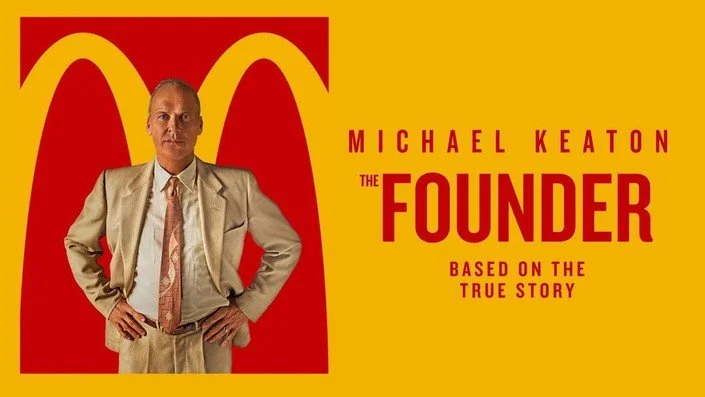
The Future Is Built, Not Predicted
Thiel’s final message is simple but powerful: progress isn’t fate — it’s design.
The future belongs to people who create it deliberately, not to those who wait for it to unfold.
He calls this idea definite optimism — believing in a future that’s both good and specific.
That resonated with me deeply, because I’ve learned that you don’t stumble into opportunity — you build the conditions for it.
You create your own luck by showing up, learning, reaching out, and forcing momentum when nothing seems to move.
When I started following SpaceX, it wasn’t just the technology that fascinated me — it was the mindset. Watching rockets land after dozens of failed attempts, seeing reusability go from dream to proof of concept — it made me believe that impossible things can be engineered into reality.
That same mindset pushed me to attend fintech and space conferences, to talk to people, and to explore where the real problems lie. It showed me that vision isn’t just about imagination — it’s about participation.
Thiel talks about “shapers” — people who don’t just react to the world but reshape it.
Coming from where I grew up, I’ve realised that anyone can do that. You don’t need permission — just direction, conviction, and the patience to keep building.
That’s what Zero to One taught me: the future isn’t something to predict.
It’s something to build.
Closing Reflection — Thinking From Zero
Looking back, Zero to One wasn’t just a book I read or a talk I watched — it was a shift in perspective.
It changed how I see creation, risk, and the idea of value itself.
Peter Thiel’s message isn’t about chasing the next big startup trend.
It’s about asking deeper questions:
“What do you know to be true that others overlook?
What are you willing to commit to, even when no one else believes it yet?”
Those questions stay with me every time I begin something new.
They remind me that originality takes courage, conviction grows through time, and clarity often comes only after failure.
I don’t see Zero to One as a business manual anymore — I see it as a mindset.
A reminder that progress, in any form, begins with an idea that looks impossible until it isn’t.
And maybe that’s what it really means to think from zero —
to stop waiting for permission,
to start shaping what comes next,
and to build something that only you can see.

Finovate Europe 2025: Conference Review
I attended Finovate Europe 2025, a major fintech conference in London that brings together banks, startups, and investors to showcase what’s next in finance. It’s fast-paced — product demos, keynotes, and discussions on everything from AI to digital payments — all packed into two days.
It was my first professional conference in London, and I honestly had fun. It felt like walking into the centre of financial innovation — a mix of sharp suits, startup energy, and endless conversations about what’s changing next.
Why I Went
The two-day delegate pass cost around £1,100, which included breakfast, lunch, evening drinks, and full access to every attendee’s contact details through the event app.
That’s the standard rate, but there were discounts available for students, press, startups, and small businesses, which makes it a bit more accessible depending on your category.
For founders, product teams, or anyone selling something, that level of access is gold. For someone like me — still researching, learning, and exploring the landscape — it was more mixed value. I didn’t go to pitch anything; I went to see where the industry is heading, talk to builders, and understand how data, AI, and regulation are reshaping finance.
There were also book signings, plenty of freebies from companies, and demo sessions that made the event surprisingly engaging. Watching startups pitch live and seeing real products on stage made it feel less theoretical and more tangible. The tech demos were genuinely fun to watch — fast, competitive, and inspiring.
What I Learned
1. Banks Are Turning Data Into Infrastructure
From the Analyst All-Stars Panel, the message was clear:
European banks see compliance as the foundation of their digital strategy.
Asia’s fintech adoption continues to lead globally.
Real-time payments are now an expectation, not a feature.
Regulation is a catalyst — the smartest firms treat it as a strategic advantage.
Banks are quietly reorganising around data as infrastructure — not just as an output. That shift is changing everything from risk management to customer experience.
2. Agentic AI Is the Next Phase
AI came up in nearly every talk. What stood out wasn’t hype, but a practical playbook for adoption:
Start with low-risk, internal use cases.
Use proven models (OpenAI, Claude) before custom builds.
Make AI everyday-use, not an IT project.
Always go through compliance, never around it.
One session highlighted the #1 impactful use case across the industry:
Strategic foresight — co-piloting decisions with AI.
It’s a shift from analytics to autonomy — systems that think, assist, and learn. That idea stuck with me because it connects directly to what I’m trying to understand: intelligent risk models that feel more like assistants than dashboards.
3. Pure AI-Native Models Are Coming
The most interesting line I heard:
“What are the models we can’t imagine yet?”
Right now, most fintech startups are just adding AI on top of old processes. But the next generation will be AI-native — companies built entirely around autonomy, data, and real-time decision-making.
Just as Facebook wasn’t a better MySpace, it was a new category — the same will be true for fintech. The winners won’t just digitise banking; they’ll redefine it.
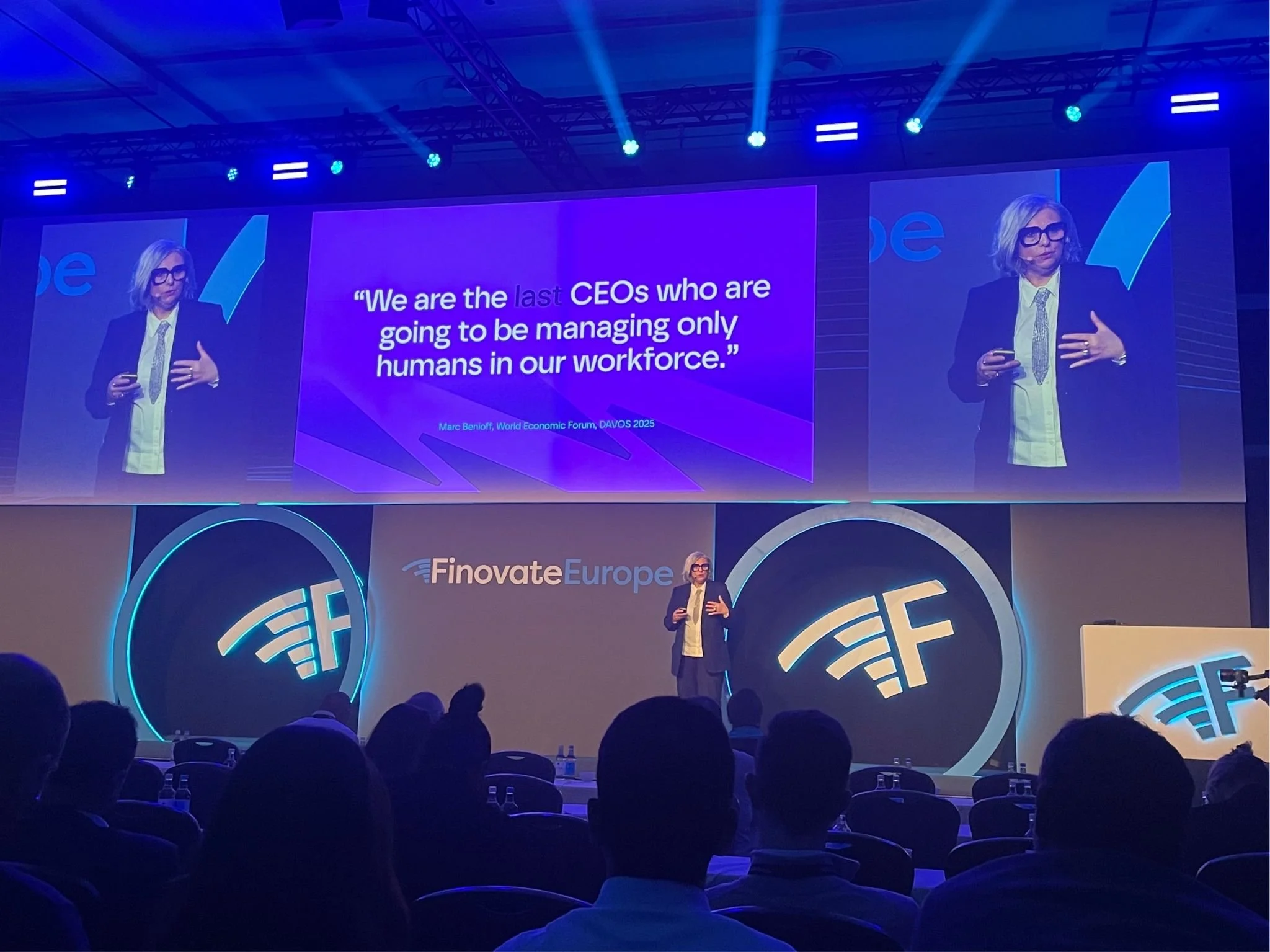
Tracey Fellows keynote address on AI.
Talks, Demos & The Atmosphere
The talks were genuinely inspiring — industry leaders shared honest insights about compliance, data, and innovation. Even as an outsider, I found it energising to hear from people who’ve built products that shape how billions transact every day.
The demos were the highlight: fast-paced, seven-minute pitches where startups showed real products live on stage. It was a great way to see what’s actually being built — no fluff, no theory. For anyone in fintech, it’s the perfect window into the competitive edge of the industry.
There were also free giveaways, company booths, and even book signings where you could meet authors and founders. Those little things made it feel like a celebration of fintech culture — not just another corporate event.
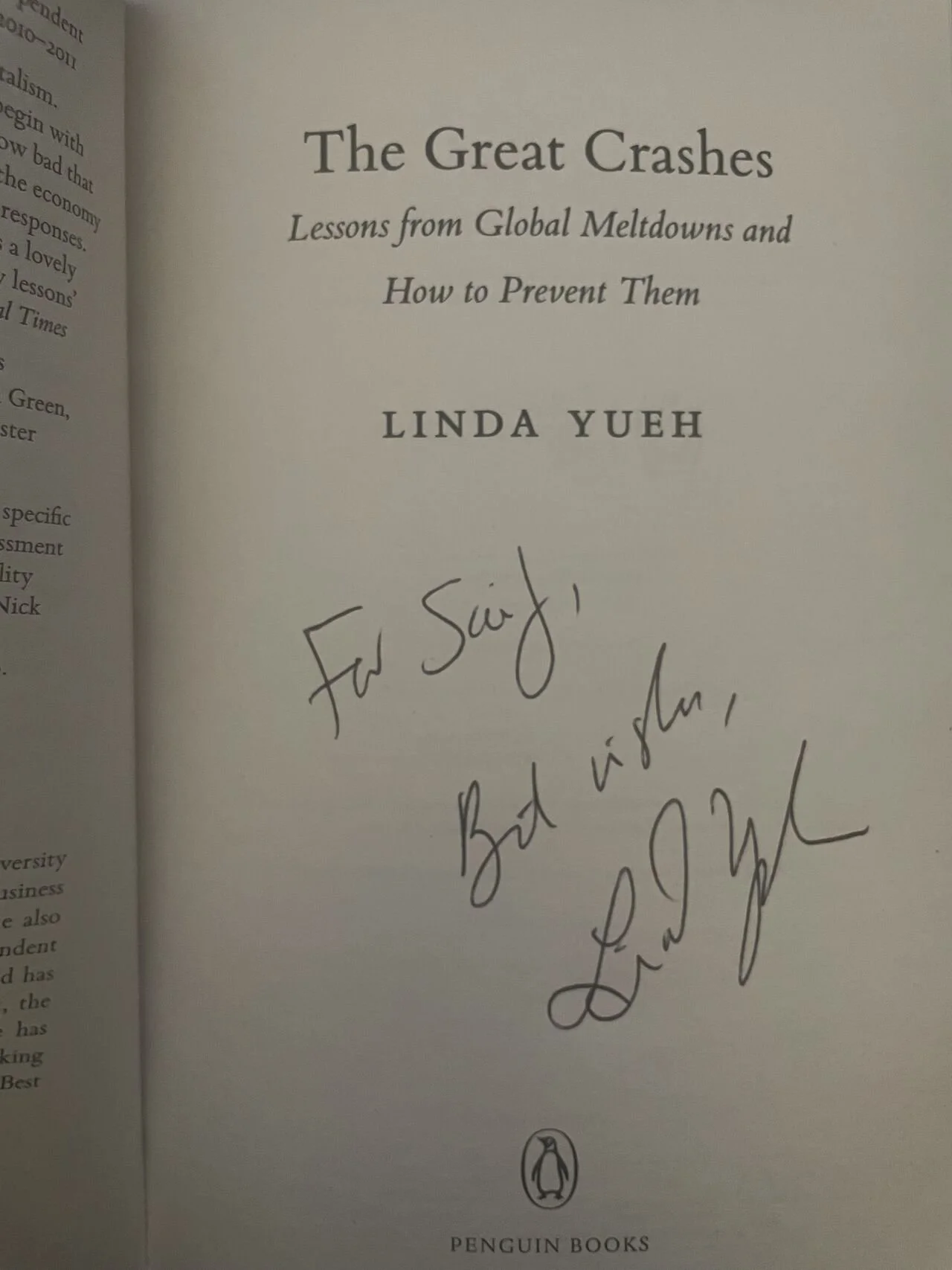
Signed after Linda Yueh’s keynote address on the escalation of geoplotical risk.
Personal Takeaways
I met a few brilliant builders and had some really valuable conversations about learning curves, building small, and failing forward.
Those chats made the event worthwhile. They also gave me the push to start vibe-coding at home — experimenting with small AI systems and automations to learn by doing.
Value for money?
For me: once, yes. Not again soon.
It was a valuable snapshot of where the industry is going, but unless you’re selling, fundraising, or deeply embedded in fintech, it’s not a repeat investment.
Exposure to new ideas⭐⭐⭐⭐
Networking quality⭐⭐⭐
Practical learning⭐⭐⭐⭐
ROI for inspiration⭐⭐⭐⭐⭐
If you work in banking or finance, or your company can sponsor your ticket, it’s worth every pound.
But if you’re more of an observer or a sponge, one visit is enough to see the landscape, absorb the energy, and walk away inspired.
Closing Reflection
Finovate reminded me that the real revolution in finance isn’t about new apps — it’s about agents: intelligent systems that learn, reason, and execute.
And sometimes, paying to watch that future unfold once is enough to motivate you to start building your own version of it.