My Vitruvian Man: Learning from Leonardo in the Age of AI
What Leonardo da Vinci Taught Me About Seeing Systems
I've always been curious about Leonardo da Vinci, but for most of my life, I only knew the caricature.
To me, he was the artist who painted the Mona Lisa. Or, if I'm being honest, I knew him as the character in Assassin's Creed who helped Ezio—the eccentric inventor who gave you the flying machine and the hidden blade.
That was the extent of it.
Recently, I've been studying great thinkers as part of my own curriculum. Leonardo was next on the list. But after watching the Ken Burns documentary and reading Walter Isaacson's biography, I realised he wasn't just a painter or a plot device in a video game.
He was something more useful: a blueprint.
Not for how to be a genius, that's too vague and unhelpful. But for how to operate in the world. How to question it. How to see systems that don't exist yet. How to teach yourself what no one else can teach you.
What landed hardest, watching the documentary, was this idea:
Leonardo lived as if the universe had given him a duty to question it.
Not just to paint or invent. But to look harder than everyone else. To test what the ancients said against what nature actually did. To keep going long after it became uncomfortable.
And once I saw that pattern in him, I started seeing it everywhere.
Franklin. Einstein. Musk.
The details differ. The centuries differ. But the structure is the same:
Question. Visualise. Build.
In an age where AI is beginning to dominate rote intelligence and logic, Leonardo's approach—curiosity, observation, cross-disciplinary synthesis—feels more relevant than ever.
This post is a dissection of his life, not as a history lesson, but as a set of principles I'm trying to apply to my own path. Because I'm not interested in worshipping great minds. I'm interested in finding the pattern. And then using it.
The Outsider Advantage
The first thing that struck me about Leonardo: he had no formal education, not by choice, but by circumstance.
His father was a notary, part of Florence's professional class. But Leonardo was born out of wedlock, which meant he was legally barred from universities, guilds, and most respectable professions. The system locked him out before he even started.
He learned in Verrocchio's workshop as an artisan; art, sculpture, engineering, stagecraft, all mixed together. No rigid curriculum. No gatekeepers. Just observation and the real work of making things.
And instead of treating this as a limitation, he turned it into method.
He read the ancients later in life, but he didn't worship them. When Aristotle said water flows a certain way, Leonardo built channels and watched. When the texts claimed the body worked a certain way, he dissected cadavers and drew what was actually there.
He was careful, of course. He understood the constraints of religion and power. He framed his observations in ways that wouldn't get him labelled a heretic. But underneath, his approach was radical:
Nature is the primary text. Everything else is commentary.
And through this approach, he proved something that still matters: you can understand anything in existence through observation of nature and apply it to human challenges. You don't need permission from the system. You can question the foundations laid by past thinkers and still discover new ideas, even in a world that claims everything important has already been thought.
I see the modern version of this now.
I have a law and history degree. No formal STEM education. No engineering background. On paper, I shouldn't be building AI-driven risk systems for space missions.
But here's what's changed: in 2025, you can do anything you want to do, as long as there's a real problem and you're learning to solve it. That's where value lies. Not in credentials. Not in gatekeeping. In whether you can actually build something that works.
That's why I'm taking the risk to leave a stable corporate job and move into the next frontier. Not because I have the "right" background, but because Leonardo proved the pattern:
When you're locked out of the system, you learn to see reality directly. And sometimes, that's the only way to see it clearly.
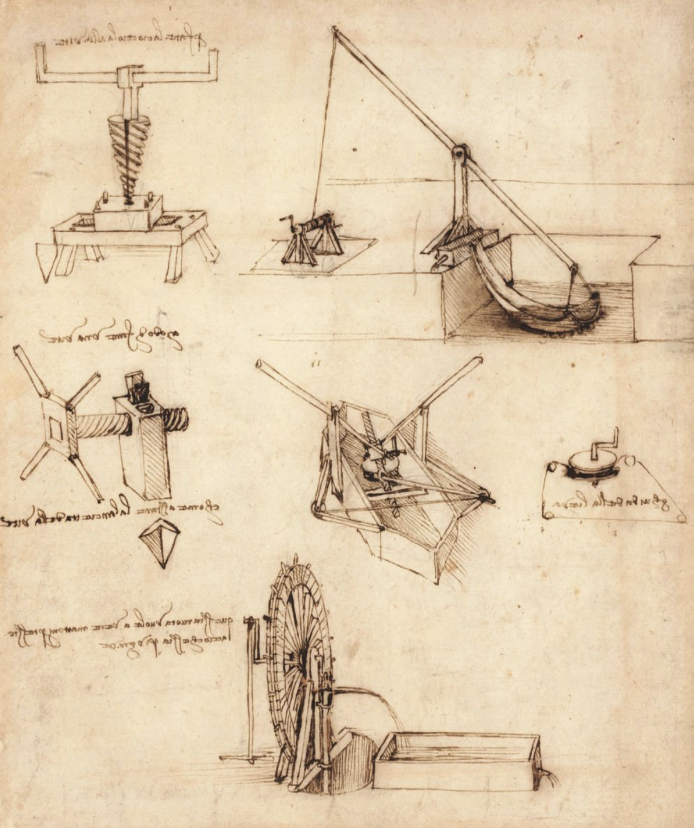
Codex Atlanticus, folio 156 r - Methods for lifting water.
Seeing Systems Before They Exist
Leonardo's notebooks aren't filled with essays or long arguments. They're filled with drawings.
Thousands of them. Machines that wouldn't be built for centuries. Anatomical studies mapping structures no one else had seen. Helicopters, tanks, diving suits, all sketched in precise detail, decades before the technology existed to make them real.
He wasn't just recording observations. He was visualising how systems would behave before they existed.
The Vitruvian Man is the perfect example. It started as ancient Roman text about human proportions. But Leonardo didn't just read Vitruvius and move on. He rebuilt it in his own visual language, circle and square, body and cosmos. The drawing became a way of seeing the relationship between human form and universal structure, not just describing it.
Walter Isaacson calls people like this "visual seers." Not just analytical. Not just intelligent. But able to hold entire systems in their mind's eye and watch them move.
I recognise this pattern in others: Musk, Einstein, Franklin. They don't solve problems sequentially. They see the whole structure first, how pieces fit together, the feedback loops, the constraints and then they build toward that vision.
I'm starting to notice the same shift in how I think.
Constantly making notes and asking questions when reading or watching something when previously no action was taken and the experience was not incorporated effectively into my mind. When designing AION's risk engine, I have to see beyond Module 1 to make sure the entire system is modular and flows from one to another in logic and design.
The pattern is: moving from understanding ideas to seeing systems.
And this matters more now than ever.
If AI can handle the rote logic, the "what does this paper say?" layer, then the real edge shifts to questions machines can't answer yet:
What systems can you imagine that don't exist?
What questions should we be asking that nobody else is?
What needs to be built that no model can generate for you?
Leonardo did this with charcoal and ink. The tools change, but the principle doesn't.
Because you cannot build what you cannot clearly see. And in frontiers like space and AI, the answers haven't been written yet.
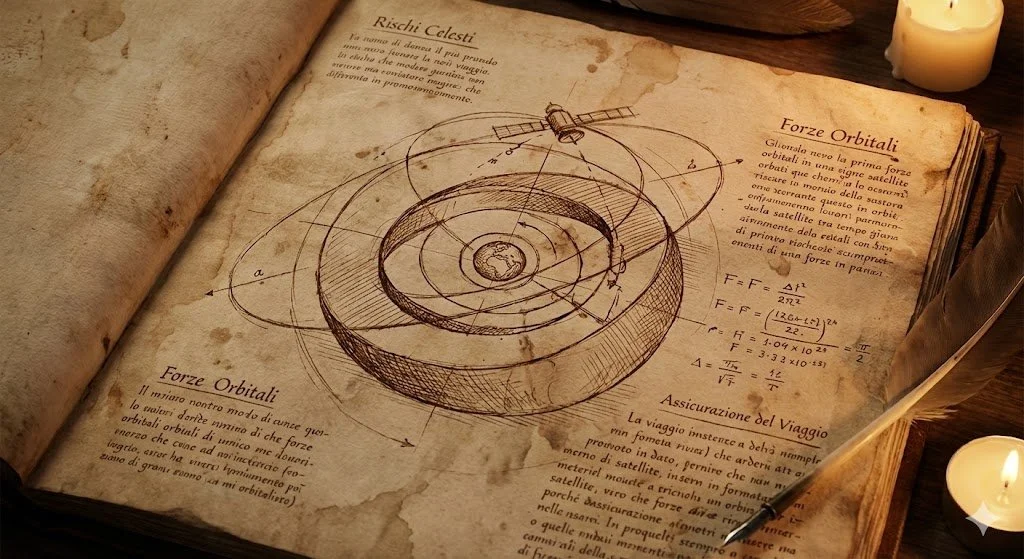
Modern system sketched in Leonardo's style — bridging 15th century and 2025
Demons as Fuel
There's a darker pattern Walter Isaacson points out in his biographies of both Leonardo and Musk.
Great thinkers usually have demons.
For Leonardo, it was illegitimacy, abandonment, the feeling of being an eternal misfit in a structured society. For Musk, it was a brutal childhood. Isaacson argues these demons aren't just unfortunate side effects, they're often the engine. They drive the restlessness. They create the need to prove something that can never quite be proven.
I have to be honest about this: I don't think you can become a high-level creator without some damage.
If I didn't have my own childhood trauma, I'd probably be part of the comfortable 95%. I would've taken the promotion at KPMG. I'd be content with the stable salary, the weekends off, the quiet life.
But I'm not built that way.
My demons are fuel. There's a part of me constantly at war, needing to prove to myself and to the world that I can build something that matters. That I'm not just here to exist, but to shape the system.
This is dangerous energy. It comes with a cost. It strains mental health. It puts pressure on relationships. It makes it hard to just "be."
I'm fortunate to have a partner who understands the mission. But I've also accepted that if you want to sit in the same category as the historic greats, you have to live with a certain level of internal turbulence. Your mind won't always be peaceful. And peace rarely leads to breakthrough.
The goal isn't to exorcise the demons completely, that would kill the drive.
The goal is to harness them. To point that obsessive energy at a problem like space risk or systems architecture, rather than letting it consume you.
Leonardo lived with his demons his entire life. They drove him to dissect thirty corpses in cold rooms. To spend years on a single painting. To design machines no one would build for centuries.
He didn't eliminate the friction. He converted it into work.
That's the pattern I'm learning to follow.
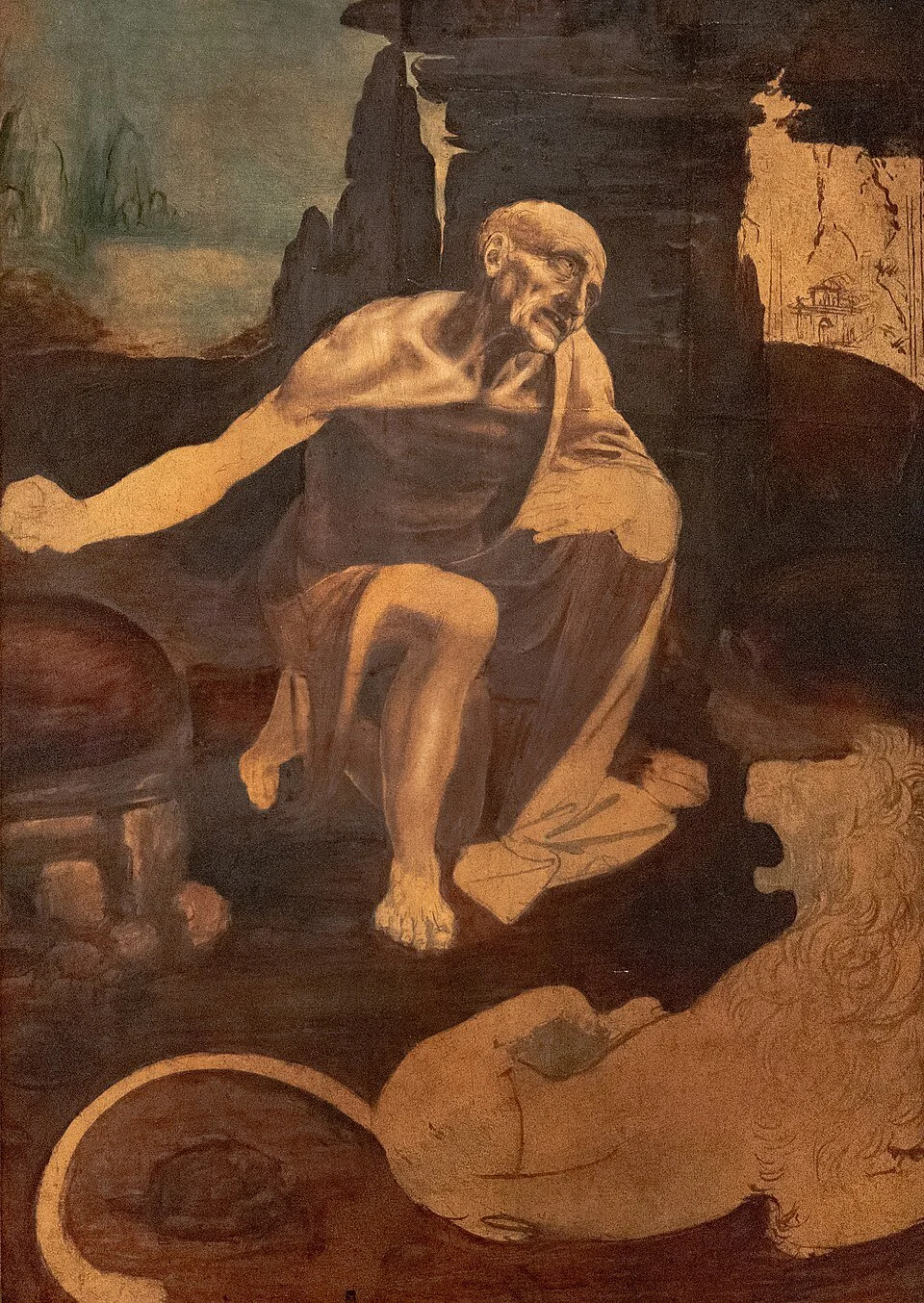
Leonardo da Vinci St. Jerome in the Wilderness (1480-1490)
My Vitruvian Man
If demons are the engine, then the question becomes: what vehicle are you building around them?
Leonardo answered that in his own way with the Vitruvian Man. It wasn't just a clever drawing. It was a statement about proportion—about how a human being should fit inside the circle of the cosmos and the square of human order.
I've started thinking in those terms for my own life.
If I know I'm wired for obsession, I can't just "see what happens" over the next decade. I need structure that can hold that energy without cracking.
So here's the question I'm trying to answer: What is the Vitruvian Man of my life?
It stands at the intersection of two worlds:
The Circle: The Cosmos
Space, uncertainty, nature. The questions we haven't answered yet. The expanding edge where the rules are still being written.
The Square: Human Systems
Law, markets, institutions, power. The structures we've built to organize complexity and behavior.
I don't want to live only in one or the other. If you disappear into the circle, you become a detached theorist. If you stay trapped in the square, you become a bureaucrat. The whole point is to stand in the middle and move between them.
I've started mapping my own limbs:
Head — The Philosopher King
This is the duty to question. Reading the ancients not to worship them, but to steal their questions and test them against 2025. Understanding why before jumping to how. Accessing wisdom from Plato and Aristotle the past thinkers and applying it to the future. If this part wastes away I drift into building clever toys with no spine.
Left Hand — The Builder (My dominant hand)
I'm left-handed, so this is the building hand. Software Development, products and new systems. Taking vague ideas about space risk and turning them into something an underwriter can actually click on. This is where "visual seer" has to become "working product."
Right Hand — Law, History, and Persuasion
The other hand is context and leadership. Understanding how power, capital, and decisions move through institutions. Being able to explain, persuade, and pull people into a vision. You can't shift a system if you don't understand its history or speak the language of the people inside it.
The Body — Vitality and Presence
The mind cannot function without the vessel. This is about physical discipline—gym, golf, diet, looking after the machine that carries the brain around. Not for vanity, but for projection. To lead, you must project energy and confidence. If the body is weak, the system fails.
The Feet — Capital and Grounding
Both feet planted in reality. Finance, risk management, capital allocation. Making sure I'm not building a grand theory while my real life collapses. You can have your head in the cosmos, but your feet must be planted on a balance sheet.
Around the figure, three laws that hold the structure together:
Temperance — No excess. No self-destruction. Demons as fuel, not fire.
Lifelong Learning — Apprentice → Master → Philanthropist.
Love and Respect for Others — Not becoming so obsessed with systems that I forget humans. Mentorship, teaching, building things that actually help.
This is what I'm building toward: a polymath life that connects across disciplines, stays physically and mentally sharp, and has enough moral weight to be worth taking seriously.
Most careers force you to slice yourself into a single sliver of this diagram. You're just a lawyer. Just an engineer. Just a consultant.
But the lesson I'm taking from Leonardo is that true insight, the kind that shifts paradigms, happens when you refuse to slice yourself up.
It happens when you let the engineering inform the philosophy, and the history inform the code, and the physical vitality power the whole structure. When you stand at the intersection and see patterns nobody else can see because they're trapped inside a single domain.
That's the architecture I'm trying to build. Not a career. A system capable of operating at the intersection of cosmos and institutions, asking questions nobody else is asking, then building the tools to answer them.
It's not finished. It's not perfect. But it's starting to take shape.
And that's the point Leonardo taught me: you don't wait until you're ready to draw the diagram. You draw it while you're becoming it.
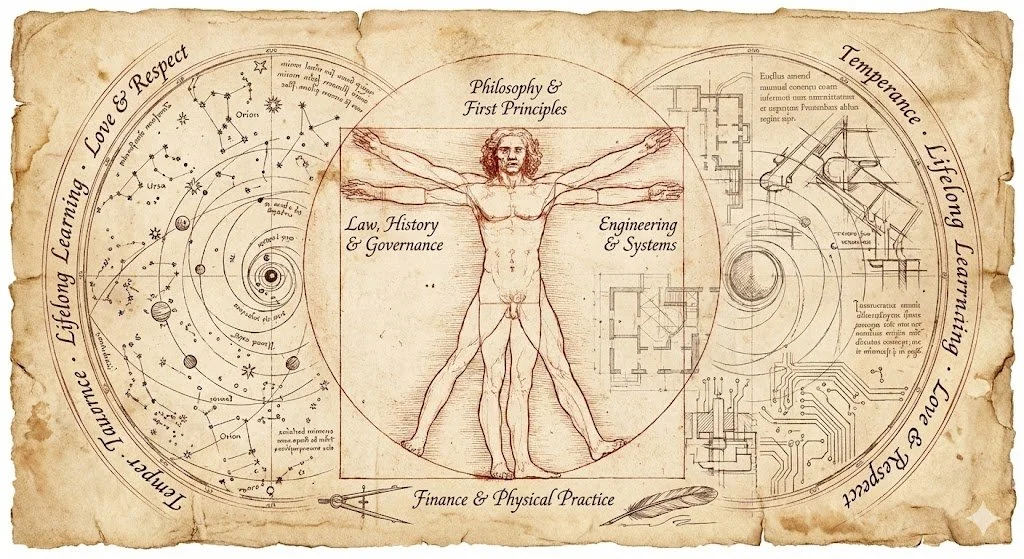
My Vitruvian Man
The Duty to Question the Universe
Leonardo believed his duty, given by the universe, was to question it.
Not to accept what the ancients said. Not to settle for approximations. But to look harder, sketch what he saw, test it against reality, and keep going even when it became uncomfortable.
I've realized I have a version of that same duty.
Not to paint the Mona Lisa or design flying machines. But to build tools and models that help us operate in uncertain, high-stakes environments, for the time being that is the Space Economy but there will always be areas where the answers haven't been written yet that I can diverge into.
To do that well, I need to become the kind of person who can hold law, history, engineering, finance, and philosophy in one mind. Who can visualize entire systems before they exist. Who can ask the right questions, then build the answers.
I'm not there yet. But I'm starting to see the pattern.
And in 2025, in an age where AI can handle the rote logic and the surface-level analysis, the real edge is exactly what Leonardo proved five centuries ago:
The capacity to see what doesn't exist. To question what everyone else accepts. To build the systems that shape reality, not just describe it.
That's the blueprint I took from watching his life.
That's what I'm building toward.
Pillars Of Creation