AION: Module 1 Phase 2
Building a Risk Engine That Underwriters Can Trust
Phase 1 of AION gave me something simple but valuable:
a loop that could take a mission, run a model, and explain its result.
Phase 2 raised the standard.
The question this time wasn’t “Can I build a risk model?” but:
“Can I build one an underwriter would trust for a first-pass view?”
That meant moving away from toy numbers and towards something closer to real insurance work: probability curves, calibrated priors, realistic failure rates, and a pricing engine that behaves like a disciplined actuarial tool, not a demo.
Opening the Model Up: Real Failure Curves
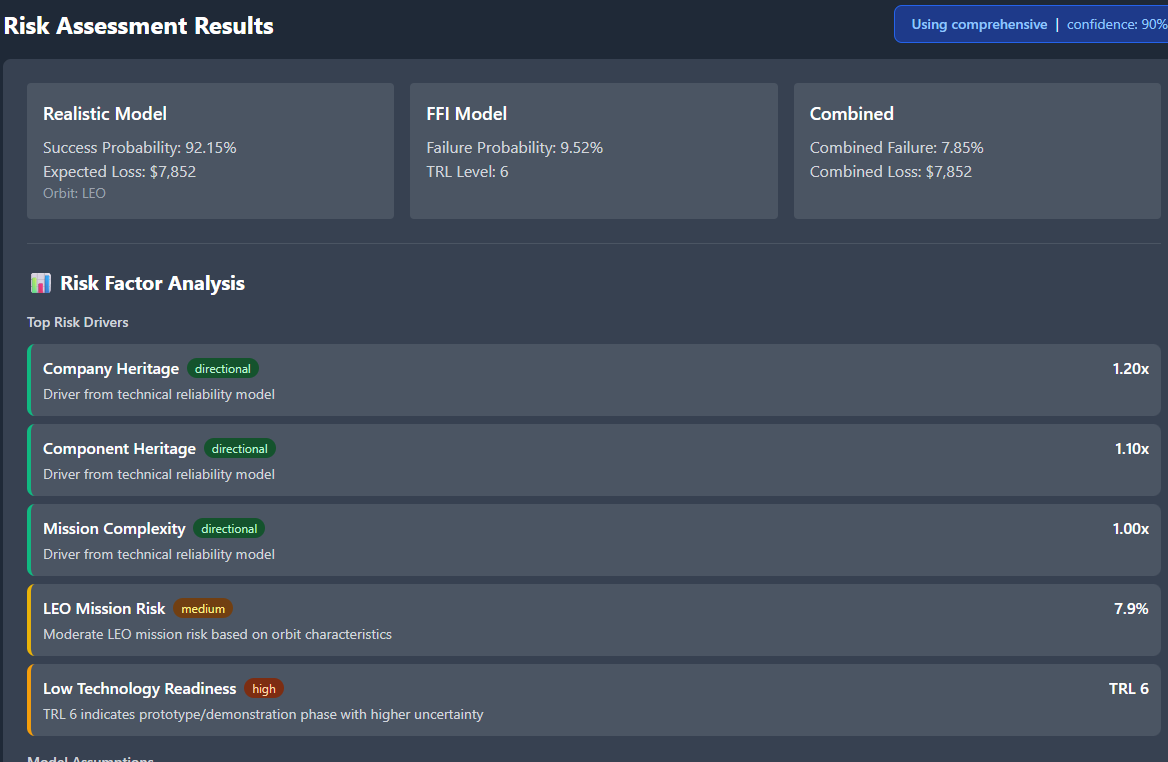
The first breakthrough in Phase 2 was replacing linear logic with proper survival analysis.
The engine now uses:
A Weibull lifetime curve
(infant mortality → stable phase → wear-out)A Bayesian update model for TRL and heritage
A reliability model tuned by orbit and launch vehicle
Hardware doesn’t fail in a straight line.
It fails according to curves, and capturing that shape immediately made the engine feel more aligned with historical space behaviour.
A positive example: fixing the inverted TRL priors.
In Phase 1, immature tech was being treated as safer — a comforting mistake.
Correcting it made the system more honest and more useful.
A Pricing Engine That Shows Its Working
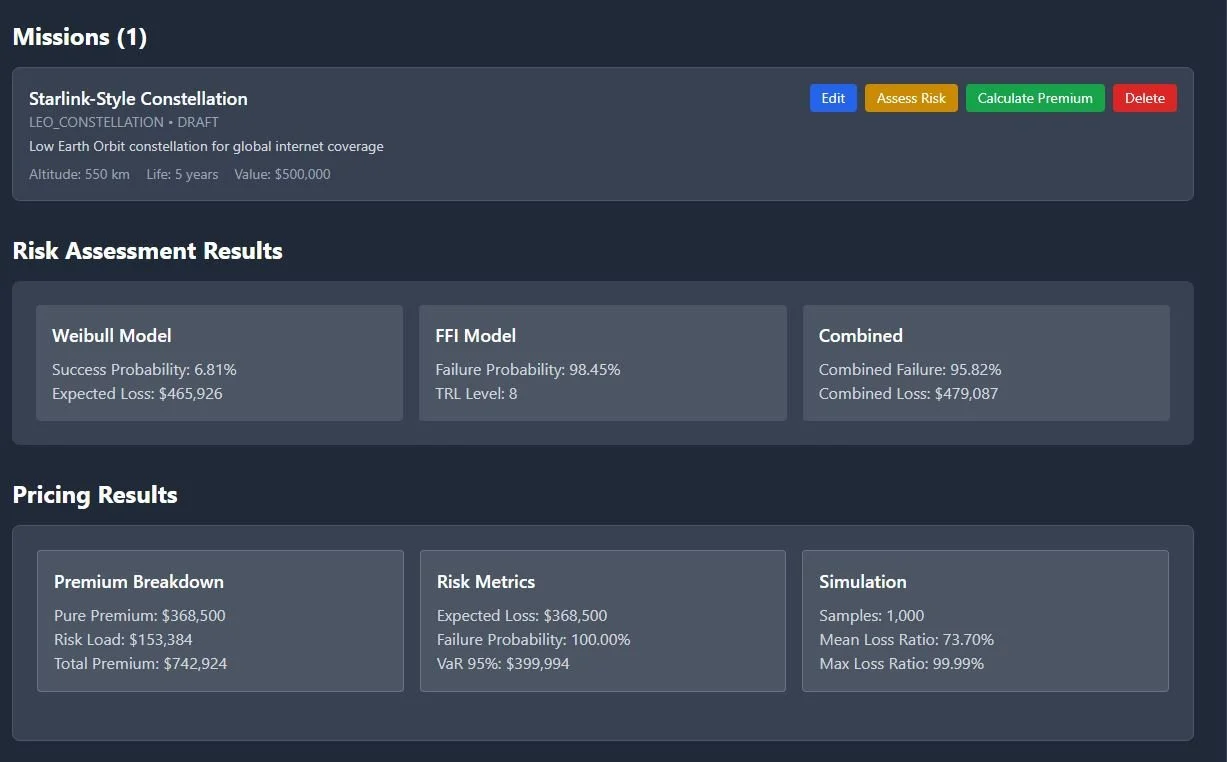
Phase 2 introduced a Monte Carlo pricing engine with:
Premium bands
VaR95 / VaR99
Tail loss behaviour
Decomposition across pure, risk, catastrophe, expense, profit
Calibration against simple industry bands
(LEO: 5–15% of SI, GEO: 1–5%)
The engine now runs 50,000 quantile samples (seeded for reproducibility) and treats price as a consequence of the probability curve, not a lookup table.
The most important addition was the explicit premium decomposition:
Here is what drove the risk.
Here is the impact of each adjustment.
Here is why the premium sits here.
It forced me to think like an underwriter rather than a developer.
Calibrated Priors: Bringing Discipline to the Numbers
Phase 2 introduced a more disciplined calibration layer:
Blend weighting: 0.09·model + 0.91·prior
Orbit caps: LEO 0.12, GEO 0.06
Realistic failure rates: Falcon 9 ≈ 97.7% success
Severity modelling:
20% total loss
80% partial loss (Beta distribution, 10–40% SI)
These numbers aren’t perfect, but they stop the model from being overconfident just because the Monte Carlo chart looks pretty.
Calibration isn’t a cosmetic step — it’s a form of intellectual honesty.
Adding Environmental Sensitivities
Space isn’t a static environment, so the model shouldn’t be either.
Phase 2 added:
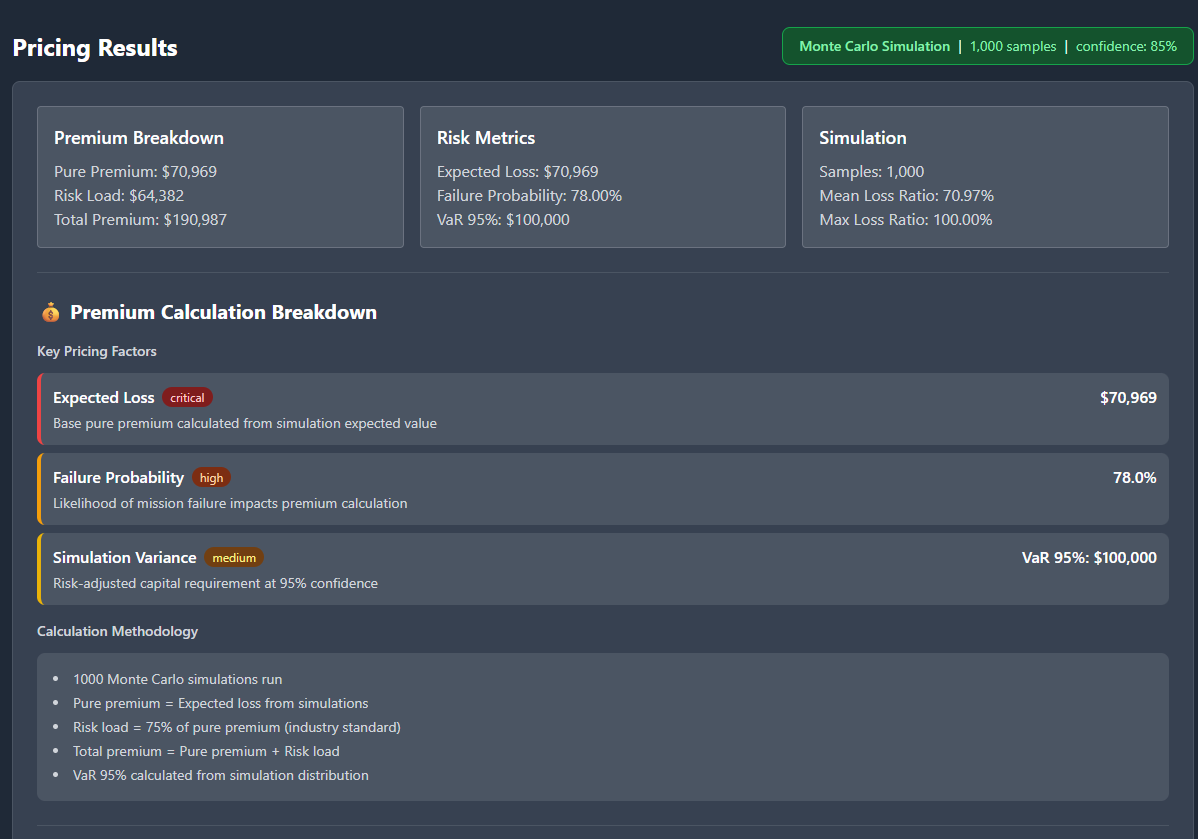
Conjunction density → increases probability
Solar activity (solar_high) → increases severity and thickens the tail
These modifiers aren’t meant to be hyper-accurate.
They’re meant to teach the right behaviour:
Risk is dynamic.
Compliance: The First Signs of Real-World Constraints
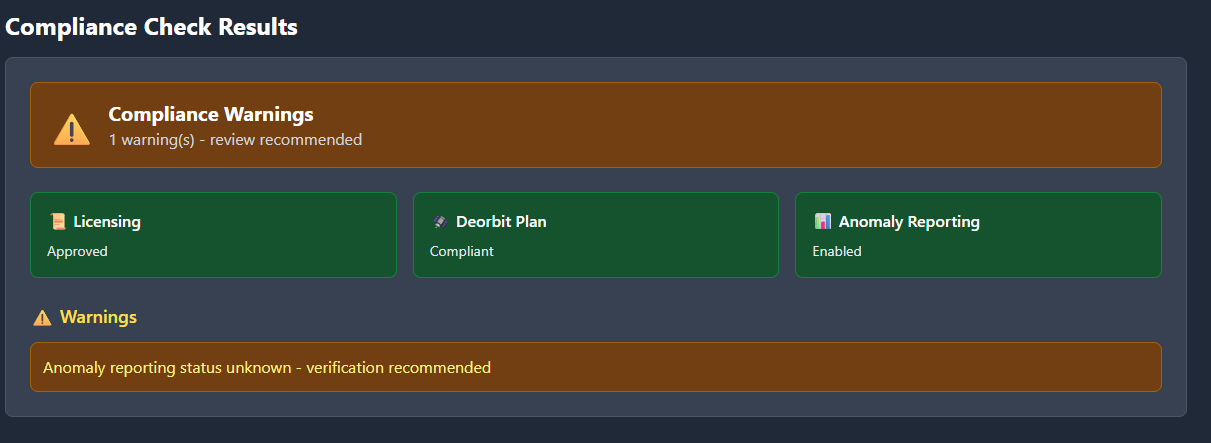
I added a light compliance layer that addresses the following areas:
licensing
deorbit planning
anomaly reporting
grey-zone mapping (
fallbacks.yaml)
If a mission is unlicensed, the model applies a simple, transparent rule:
+10% premium, via a feature flag.
It’s the first time AION began to link technical risk with regulatory exposure — something Phase 1 ignored entirely.
A Mission View That Reduces Cognitive Load
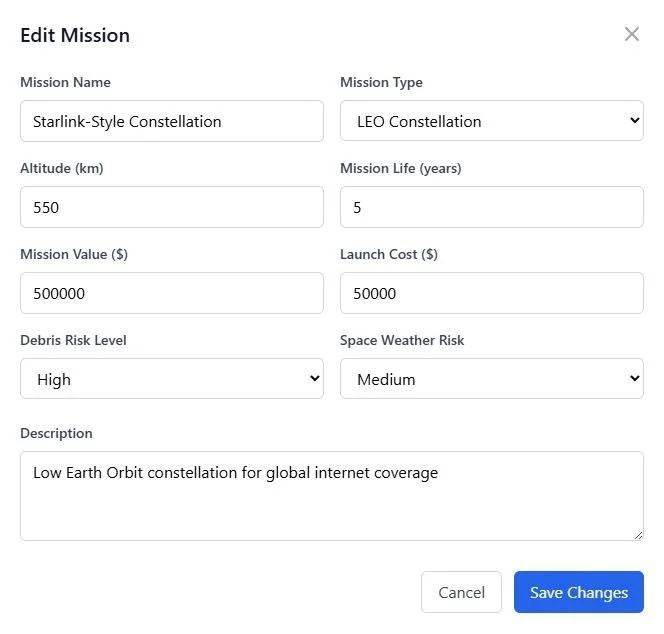
Phase 2 reorganised the UI into a single mission workbench:
Mission profile
Risk band + confidence
Pricing band + decomposition
Compliance flags
Environmental modifiers
An assumptions drawer showing the engine’s reasoning
Adjustment chips explaining signal impacts
It’s not polished.
But it has a calm structure you can actually think inside — which is more important at this stage than visual flair.
Reducing cognitive load was the whole point.
What This Phase Taught Me
Modelling is a negotiation with reality.
Every fix — inverted priors, overflow issues, curve tuning — revealed where intuition diverged from the world.
Underwriters don’t want a number; they want the reasoning trace.
The more transparent the model became, the more confident I became in its behaviour.
Calibration is honesty encoded as math.
Small parameters grounded the system more than any big feature.
Tools shape thinking.
Designing a single mission view changed the way I built the model itself.
What Phase 2 Sets Up
Phase 2 didn’t finish the engine.
It clarified the foundation.
It taught me to build something that:
behaves predictably
explains itself rigorously
stays within calibrated bounds
is structured for future extension
can sit in front of a professional without apology
Phase 3 will focus on refining the narrative layer:
clearer assumptions, more consistent reasoning, and a tighter link between risk, environment, compliance, and price.
But for the first time, the engine feels usable.
Not finished.
Not perfect.
But grounded enough to build on with confidence.